A Guide to FATCA


Struggling to understand the implications of the introduction of the Foreign Account Tax Compliance Act (FATCA)?


The unintended impact of FATCA means US expats have an ever decreasing number of places to turn to for financial advice and a dwindling number of investment products to choice from.

The introduction of the Foreign Account Tax Compliance Act (FATCA) from 1st July 2014 is causing widespread panic among US expats.

Under FATCA, non-US banks and financial institutions with American clients must separately report those account details directly to the IRS. This is leading to many offshore banks, providers and other institutions refusing to deal with wealthy US expats, because they do not have to deal with the cost, complexity and risk of dealing with the IRS.

This means that US expats now have fewer and fewer choices when it comes to financial advice and wealth management. And this reduction in the choice of investment vehicles and savings options is becoming problematic. The number of cases where Americans have given up their citizenship because they’ve felt overwhelmed by this new tax law and incensed by having to consider financial options that are not only tax inefficient have risen sharply over the last 3 years and we foresee this figure only getting bigger – http://www.bbc.com/news/35383435

The US is virtually unique in requiring all US citizens wherever they are in the world to report their income to the IRS at an individual level. And with top rates of income tax up from 35% in 2012 to 39.6% today, ditto capital gains tax and the tax on ordinary dividends also now 39.6% (up from 15% in 2012), the challenge, particularly for high net worth US expats, is to achieve a tax advantage on savings that is otherwise subject to the above rates, while at the same time remaining FATCA compliant.

While it is possible for US taxpayers to obtain income and capital gains tax deferral using traditional qualified variable annuity contracts, the costs of these contracts can be quite significant.

The solution is built around the US/Maltese double tax treaty, which means income and gains within the plan are not subject to US Federal taxes. What’s more, as a qualifying plan for US tax purposes, members can claim relief on realised income and gains generated within the plan, saving between 20% and 39.6%.


The problem

As an American expat you are still liable to pay tax on your worldwide income, albeit with some additional benefits to mainland residents. With the introduction of FATCA, international financial institutions now have to report any US tax-paying clients to the IRS, resulting in burdensome reporting and often unprofitable business. The result being that US expats are now being shunned by many financial institutions leaving it difficult to find advice or support.


The Solution

Despite the new rules though, there are still many ways you can legally minimise your tax liability, often through the use of Double Taxation Agreements (DTA’s), recognised by the IRS as compliant savings schemes. The use of such schemes in safe jurisdictions can result in greater flexibility over your savings, including access and investment choice along with the massive benefits of Gross Roll-Up or Deferred Taxation.


Key Points:

  • Ensure your savings plan has as much diversity as possible to capture market gains, balance volatility and reduce risk.
  • Verify that your savings vehicle complies with reporting obligations and does not penalise you for withdrawals or compromise your tax position.
  • Check any savings plans are held in politically stable jurisdictions on good terms with the US.


FAQ’s


What should I be doing?

All US taxpayers must report all earned and unearned income and worldwide assets every year. On top of this you must also disclose the details of every bank account that you have power of signatory over, if the total value of your overseas bank accounts is in excess of $10,000.


How do I remain tax efficient?

From 2013, the top rate of income tax increased from 35% to 39.6% along with short term capital gains tax and the tax on dividends, whilst long term capital gains tax remained at 20%. Therefore the most basic planning advice would be to structure your investment portfolio to give rise to long term capital gains – rather than short term.


How can I use my pension?

Whilst overseas, US taxpayers can continue to contribute to Individual Retirement Accounts (“IRAs”) back in the US. You have a choice whether to fund a Traditional or Roth IRA and either claim tax relief on the way into the pension – or on the way out as you draw income.


Long term savings options

Building up a substantial savings pot is a key priority and best achieved using a wide range of investment opportunities.

Such a strategy introduces diversity into a savings plan and reduces risk. However, for US expats the need to comply with IRS tax reporting as well as the introduction of FATCA means the underlying plan structure is an additional consideration. For long term savings or retirement plans you need to check on any restrictions on withdrawals in terms of age and percentage of the plan’s value which you are able to take out.

Withdrawals can be taken as an initial lump sum of up to 30% of the total value of the plan or as part of ongoing programmed withdrawals. This approach not only provides gross roll up to defer US tax on realised income and gains on investments, but an absolute saving can be achieved through paying untaxed income and gains in the form of a lump sum and/or programmed withdrawals, which will not be subject to either US Federal taxes or Maltese withholding taxes.


How will FATCA affect my Retirement?

There is still a level of uncertainty on how FATCA could impact certain company or state sponsored retirement funds of US employees working abroad. News reports pointing out restrictions on underlying investments may result in changes to member plans in order to comply.

By structuring plans as a Foreign Grantor Trust, the IRS accepts that the value of the plan forms part of the member’s estate for US Estate Tax on death. This means there is no limit on the level of savings which can be contributed to the plan as contributions are not removed from the member’s US estate.

While contributions made to such a Plan will not receive US tax relief, they can be made in a wide variety of forms such as cash, existing investment portfolios, life assurance policies or shares in mutual funds.


All the best and if you would like any further information please let me know as this subject can get extremely complicated.

Stuart

CEO

Farringdon Group

+60 3 2026 0286

FinTech service to offer PE deals to Asia’s HNWI

Singapore’s Farringdon Asset Management plans a service matching ultra-high-net-worth investors (UHNWIs) with private equity investment opportunities.

The new application called Mercury is designed to match UHNWIs with private equity opportunities valued between $100m and $500m.

It will be launched during Singapore’s Fintech week in November, the company announced.

Farringdon is in negotiation with “several investment banks and PE firms” with a goal to establish a deal pipeline, according to Martin Young, CEO of Farringdon Asset Management.

The firm is targeting individuals with demonstrable assets of at least $30m and institutions with at least $500m. It plans to offer deals in the equity and debt space with a minimum investment of $5m per client. The service will be available to institutional clients worldwide, but it will also target individuals in the Asean countries, Young told FSA.

“We have seen an increasing trend for ultra high-net-worth individuals to invest directly into the kind of debt and equity deals previously reserved only for banks and large institutions,” Young said in a statement. “Mercury is designed to support that trend and get these investment opportunities out to a wide network of potential buyers.”

“Many Asian investors seek out high quality investment opportunities in places such as Europe,” said Ana Isabel Gonzalez, director of Farringdon Asset Management.

“The greatest opportunity for such investment is in the $100m to $500m space. This investment size is often too small for investment banks and institutions but too [high] for single investors. Such projects are turning more and more to so called ‘club deals’ which Mercury will help to facilitate.

Farringdon operates Algebra, a robo-advisory service offering sharia-compliant portfolios to investors in Malaysia, which was launched in July.

Mercury will use the same robo-advisor technology. “The underlying investment preference algorithms will be adapted to private equity- type investments and away from the security-based investments that Algebra uses,” Young said. “Over time we intend to incorporate machine learning into this to help better capture investment preference.”

Farringdon has announced that the service will be accessible via mobile channels, through iOS and Android apps. “There will be a website as well although the fast paced nature of such deals will mean that most transactions will take place via mobile apps,” Young said.


Courtesy of Fund Selector Asia

Robo-Advisors ready to morph Malaysia’s Islamic Finance Industry

Fintech plays plow forward in Southeast Asia as robo-advisor technology emerges as an important trend in Shariah-compliant investments – especially in Malaysia

As the fintech space continues to transform Southeast Asia, robo-advisor technology is emerging as a unique trend in Shariah-compliant investments. This is especially true in Malaysia, where artificial intelligence (AI) could endanger fund managers’ jobs while introducing new investment options to stakeholders.

Robo-advisors are algorithm-based products designed to manage asset portfolios by matching individual risk appetites against stock indexes. They’ve been around for years, but have yet to truly penetrate the global Islamic fund and wealth management market, whose assets under management (AuM) at the end of the first quarter of 2017 stood at $70.8 billion, according to estimates by the Malaysia Islamic Financial Centre and Thomson Reuters.

Shariah-compliant robo-advisors emerged in Malaysia in mid-2016, said Natasha Ishak, manager of banking and financial services at recruitment agency Hays Malaysia. Ishak works closely with the country’s banking industry executives, and her work includes research into the potential disruptions that technology will bring to the sector. She estimates Malaysia will likely see a surge in robo-advisor activity within the next three years.

“Right now robo-advisors are still mainly being used for high-frequency trading, so it’s not as developed as it could be,” Ishak told Salaam Gateway. “If we look at Malaysia itself, in terms of the infrastructure and the algorithms they’re plugging into the robo-advisors, it’s not as sophisticated as I’m sure it will be ten years from now.”

Robo-advisors can potentially shake up the wealth management industry in Malaysia by offering cheaper and more efficient options to a segment that has historically not had much access to investment advice.

Malaysia is in a unique position when it comes to robo-advice due to its leading position in Islamic finance and its Muslim-majority population of middle-income earners.

Islamic finance has an established presence and is highly visible on Malaysia’s financial landscape. The country has the highest number of Islamic funds in the world, totalling 328 in 2016, with assets under management (AuM) of 149.64 billion Malaysian ringgit ($34.9 billion), equivalent to 21.49 percent of total AuM, according to Malaysia’s Securities Commission. The nation’s Islamic funds AuM is second only to Saudi Arabia. The size of the nation’s Islamic capital market was 1.7 trillion ringgit in 2016.

Policy-wise, Malaysia’s government released its five-year Islamic Fund and Wealth Management blueprint in January this year that sets out strategy to position the country as a global hub for Islamic funds, establish it as a regional centre for Shariah-compliant sustainable and responsible investment (SRI), and develop it as an international provider of Islamic wealth management services. At the same time, the country’s securities regulator and central bank are working to hash out regulations for fintech companies looking to establish themselves through a sandbox initiative, which is currently underway.

‘AN EFFICIENT ALTERNATIVE’ 

New York-based Wahed Invest, the world’s first Shariah-compliant robo-advisor, was built on the theory that the biggest value-add of the tech is its ability to be hyper efficient without compromising on ethics. “We built this to provide an efficient alternative, and to prove that there does not have to be a cost to being Muslim,” the company’s CEO Junaid Wahedna told Salaam Gateway.

Wahedna points to excessive charges imposed on clients, particularly those who choose to invest in line with Shariah. Costs such as custody fees, management fees and brokerage fees can come up to a whopping 3 percent of the total investment, and are opposed to Islamic laws with relation to interest rates. For players like Wahedna, these elements are seen as impediments to efficiency, resulting in an industry that lags 20 years behind its conventional counterpart.

“The whole process is inefficient; people are paying up to 3 percent in fees just for investing in a halal way,” he explains. “No active manager can beat the market consistently after its fees are taken into account, and studies and math show that.”

According to PricewaterhouseCoopers (PwC) 2016 Global Fintech report, robo-advisors come into play by introducing “more transparent, traceable, efficient and customer-centric standards along the overall value chain” by delivering “easier, faster and more user-friendly investment based solutions.”

Wahedna says his company’s robo-advisors reduced the inefficiencies in the market by cutting out ‘middleman fat,’ while also charging a single “wrap fee” capped at 0.99 percent of the total transaction.

“You’ve got too many people with their hands out,” Stuart Yeomans, CEO of Malaysia-based Farringdon Group told Salaam Gateway. Farringdon owns Asia’s first robo-advisor named Algebra. To Yeomans, middlemen aren’t just wealth managers, but include the lawyers, sales teams and strategies that bloat costs and weaken supply chains.

“For us, being efficient and ethical is a premise, regardless of whether it slows us down or we don’t make as much money,” adds Wahedna. “I feel that’s really the point of Islamic finance – you have to put the ‘Islamic’ before the ‘finance’ because it’s quite an oxymoron otherwise.”

ACCESSING A NEW MARKET

The introduction of robo-advisors may very well open up key markets for the Islamic wealth management industry via competitive pricing and the promise of Shariah compliance, which is a tricky process even for seasoned wealth managers who usually only get certified once per year.

Shariah-compliant robo-advisors come with the assurance that all portfolio plays have been thoroughly vetted and cleared as permissible. Negative screening approves of stocks that meet the thresholds for non-permissible income, debt, and investments, and do not engage in certain business activities such as gambling, adult entertainment, pork, alcohol, tobacco, or firearms. Wahed Invest is signed off by U.S.-based Straightaway Ethical Advisory and Farringdon by Malaysia-headquartered Amanie Advisors.

The Muslim market also intersects with the growing global middle class that has largely been excluded from the investment market. According to Hay’s Ishak, middle-income earners are currently a target market for financial institutions as they make up the majority of Malaysia’s Muslim population, and are largely uninvolved in investing.

“Lower income people tend to do their own research and trade themselves, while higher income earners will have their own wealth advisors and fund managers,” she said.

Wahedna pointed out that the majority of Muslims live in the developing world, and many of them don’t possess the capital necessary to qualify for wealth managers’ services. Robo-advisors will likely be most beneficial for investors coming from this segment of the population as they do not discriminate between the assets of a middle-income earner and a high-net-worth individual.

“Even if you only have $100, your expected return capital is the same as someone with $10 million,” says Wahedna. “It’s bringing democracy to your investing.”

RETHINKING INCUMBENTS 

The biggest losers of the rise of robo-advisors will be traditional wealth managers and advisors, who will have to compete to stay relevant amidst a technology revolution. Ishak pointed out that robo-advisors are dominating more than 80 percent of daily traded stock in mature markets. Wealth managers will likely lose out in the retail sector, which is where robo-advisors will make the biggest impact.

The cheap AI version will easily claim 50 percent of that lower segment of the investment spectrum in the next decade, said Yeomans.

However, wealth managers won’t face serious competition for their high-net-worth clients, who prize a personalized experience over cost. Yeomans said it is highly unlikely we will see millions being invested via a robo-advisor, and in fact, Farringdon core traditional wealth advisory business is subsidizing the tech. He added that Farringdon maintains its traditional services to cater to its high-net-worth clients with more complex portfolios and bigger risk appetites.

PwC’s report suggests that certain high-net-worth clients might not see robo advice as adding value, as they will not be able to handle the more complex aspects of their portfolios.

“If we were to look at funds that are a lot bigger in size, where the risk appetite is higher, you can’t really take out the fund managers and financial advisors completely because the risk exposure and compliance aspect of things are not going to be covered,” said Ishak.

($1 = 4.2820 Malaysian Ringgit)

Courtesy of – SalaamGateway.com

Week 31 in Review – Tight US Labour Markets Persist


US non-farm payrolls rise

Grand jury impaneled in Russia/election probe

Dow sets record on impressive corporate earnings

Trump signs bill sanctioning Russia, Iran and North Korea

US considers trade action against China

Greenspan sees bond bubble


Global equities edged higher this week amid continued strength in US markets as another impressive earnings season unfolds. The Dow surpassed the 22,000 mark during the week, aided by a tailwind from a weakening US dollar and supportive US economic data. The euro rose to an 18-month high, acting as a headwind for shares of European multinationals but supporting commodity prices. West Texas Intermediate crude oil prices broke above the $50-per-barrel barrier at midweek, but eased to end near $49, down slightly from last week’s $49.65. The yield on the US 10-year Treasury note slipped three basis points on the week to 2.27%. Volatility, as measured by the Chicago Board Options Exchange Volatility Index (VIX), declined to 9.9 from 11.0 a week ago.


MACRO NEWS

Another solid US employment report

US labour markets remained tight in July, with the unemployment rate slipping to 4.3%, matching a recent 16-year low. The economy added another 209,000 jobs, handily exceeding the 180,000 six-month average. However, despite solid job growth, wages remain restrained, with average hourly earnings holding steady at a 2.5% annual growth rate. The upbeat data should keep the US Federal Reserve on course to begin shrinking its balance sheet in the next few months and for another rate hike before year’s end.

Russia probe ratchets up

Special counsel Robert Mueller has empanelled a grand jury in Washington, D.C., to investigate Russian interference in the 2016 US presidential election, according to the Wall Street Journal. This indicates the probe is entering a new phase and suggests it could last for months.

Dow reaches new milestone

One thousand points isn’t what it used to be, accounting for a move of less than 5% at present levels, but markets took note of this week’s milestone nonetheless as the venerable Dow Jones Industrial Average broke and closed above the 22,000 mark for the first time. Solid corporate earnings and a weakening US dollar are providing a favourable backdrop for equities amid slow-but-steady economic growth and low inflation. The growth/inflation combination could keep the Fed from tightening monetary policy more quickly than expected.

Trump reluctantly signs sanctions bill

US president Donald Trump, fearing that a veto would be overridden by Congress, this week signed a sanctions bill that targets Russia’s energy and defence sectors. Trump’s objections to the bill stem from his belief that it encroaches on the executive branch’s authority to negotiate. Reacting to the bill, Russian Prime Minister Dmitry Medvedev declared that a full-fledged trade war has been declared against Russia.

Russia also ejected 755 US diplomats and seized two diplomatic properties. The bill also includes sanctions on North Korea and Iran.

US scrutinizes China’s IP practices

The Trump administration is considering taking trade action against China and is discussing launching a probe into Beijing’s insistence that foreign companies transfer technology to local Chinese subsidiaries and partners. The administration could launch a “Section 301” action, which allows the president to impose duties on products from countries that use unfair trade practices. An announcement had been scheduled for Friday, but was cancelled by the White House without explanation. Trump also this week linked trade with lack of progress on restricting North Korea’s nuclear program, suggesting the potential for trade restrictions with China unless it takes action to restrain its neighbour.

Greenspan more worried about bonds than stocks

Former Fed chairman Alan Greenspan opined this week that we are experiencing a bubble, not in stock prices, but in bond prices. Real long-term interest rates are much too low and are therefore unsustainable, he said. Greenspan sees a return to 1970s’-style “stagflation,” or poor economic growth and rising inflation. “That is not good for asset prices,” he warned.

Czech central bank first in Europe to hike rates

While the Bank of England and the European Central Bank have been contemplating shifting to less accommodative monetary policy stances, the Czech central bank took action on Thursday, raising its main policy rate from 0.05% to 0.25%, its first hike since 2008. Rising wages and shrinking economic slack were factors behind the rate boost. Meanwhile, the BOE voted 6–2 on Thursday to hold rates steady. Markets have been on high alert since a close 5–3 vote at the June BOE meeting to leave rates unchanged raised the spectre of an interest rate hike sooner than the market had anticipated.

Venezuelan crisis intensifies after vote, arrests

Following a disputed election for a new legislative body last weekend, in which voting tallies were reportedly manipulated, and the arrest of two high-profile opposition leaders, Venezuelan president Nicolas Maduro faces increased pressure both from within Venezuela and without. The United States placed sanctions against Maduro, freezing any assets he holds in the US, and barred Americans from doing business with him. Also, anyone doing business with the newly elected legislative superbody will also be subject to US sanctions.

EARNINGS NEWS

According to Thomson Reuters I/B/E/S, with 75% of the companies in the S&P 500 Index having reported, Q2 earnings are expected to increase 11.8% compared with a year ago. Excluding the energy sector, the earnings growth estimate dips to 9.2%. Revenues are expected to increase by 5% compared with Q2 2016, and 4.1% excluding energy.


All the Best and have a great week ahead

Stuart

CEO

Farringdon Group

+60 3 2026 0286

Week 30 in Review: IMF Lowers US Growth Outlook


  • US growth sees modest Q2 bounce-back
  • Greece returns to the Bond Markets
  • Fed: Balance sheet run off to commence “relatively soon”
  • IMF lowers US growth outlook, raises others’
  • Abe’s support slides as scandals mount
  • Trump backs corporate, middle-class tax cuts

A busy week of corporate earnings injected volatility into the major European indexes. Soft manufacturing data, notably in Germany and France, at the start of the week weighed on the market. But by midweek, as earnings season was in full swing, telecommunication, technology, and utility stocks led the markets higher. However, by the end of the week, European technology stocks, hurt by earnings misses and profit taking, were a drag on Germany’s Dax and France’s CAC 40. The pan-European index Stoxx 600 finished the week lower along with the US S&P 500.


MACRO NEWS


US GDP rebounds from sluggish start to year

US economic growth accelerated in the second quarter, rising 2.6%, up from the first quarter’s 1.2% pace. Economists had expected a slightly stronger rebound, and the bounce is well short of expectations from earlier in the quarter. Wage pressures remain muted as hopes for sustained faster growth fade, given that pro-growth policies from Washington are looking less likely by the day. Modest growth averaging around 2% looks to be in the cards again in 2017. This should keep the US Federal Reserve on a gradual rate hiking path.

Greece returns to the Bond Markets

The financially strapped country returned to the financial markets for the first time since 2014 and sold about €3 billion of five-year bonds at an interest rate of 4.625%, a relatively high yield, to account for the inherent riskiness in holding Greek bonds. Greece is the rare sovereign that issues sovereign debt at a higher yield than some Greek corporates. The extra yield reflects the political risk posed by Greece’s relatively market-unfriendly Syriza government. Yields across most eurozone government bond markets broadly tracked U.S. Treasuries as they fell in the second half of the week following the Federal Reserve’s policy meeting on Wednesday.

Fed signals it’s ready to cut balance sheet soon

In a statement released after Wednesday’s Federal Open Market Committee meeting, the Fed indicated it is ready to begin trimming its balance sheet, which enlarged in the wake of the global financial crisis. In a statement, the Fed said it expects to begin allowing some of its bond holdings to mature “relatively soon.” This is a shift from earlier language, released after the June FOMC meeting, that indicated a move by the end of the year. Many expect an announcement to come at the September FOMC meeting. The Fed held rates steady while acknowledging that inflation is running below its 2% target.

IMF affirms global growth view

In a mid-year review, the International Monetary Fund maintained its forecast for 3.5% growth in gross domestic product this year. The fund lowered its outlook for US growth to 2.1% from a previous reading of 2.3% while raising its outlook for the eurozone and Japan. It downgraded its outlook for UK growth.

US health care push fizzles

Despite their effort being pronounced dead on several occasions, US Senate Republicans took up health care reform again this week after a dramatic return to the Capitol by Senator John McCain, who was recently diagnosed with brain cancer. Vice President Mike Pence broke a 50–50 tie to allow the Senate to begin debate on several Republican-sponsored legislative options. Ironically, McCain helped scuttle the final alternative, a “skinny repeal” bill that would have ended Obamacare’s individual mandate, among other provisions. Now that the health care bill has been defeated, Senate leaders hope to move on to tax reform and to passing a spending bill in order to avoid a government shutdown at the end of September.

Japan’s defense minister forced to step down

While much of the world has been focused on goings on in Washington, Japan has had to deal with a series of scandals that have undermined Prime Minister Shinzo Abe. Abe has been accused of cronyism, having helped a friend secure a license to open a veterinary school. Meanwhile, defense minister Tomomi Inada was forced to resign this week over an alleged cover-up of military documents from UN peacekeeping operations in South Sudan. Inada’s ministry is accused of concealing logs which show that Japanese troops were in increasing danger during their mission. The departure comes as support for Abe hovers near 20% in opinion polls. Despite Abe’s slide in popularity, the opposition Democratic Party has been unable to gain support, prompting the resignation this week of party leader Renho Murata after 10 months at the helm.

Trump talks taxes

Amid a swirl of controversy, US president Donald Trump, in an interview with the Wall Street Journal this week, reiterated his desire to slash the US corporate tax rate to 15% from 35% while lowering the tax burden on the middle class. Additionally, Trump kept open the option of raising taxes on upper-income earners. The president did not rule out reappointing Fed chair Janet Yellen, but said that economic advisor Gary Cohn, former president of Goldman Sachs, is also under consideration for the post. In a press release on tax reform on Thursday, congressional leaders and administration officials agreed to table the border-adjustment tax that would have taxed US imports.

Moody’s sees less China bank risk

Credit rating agency Moody’s has upgraded its outlook on the Chinese banking system to stable from negative. Moody’s sees receding concerns over China’s massive shadow banking sector following action from regulators to curb systemic imbalances. It also expects nonperforming loans to stabilize near current levels.

EARNINGS NEWS

According to Thomson Reuters I/E/B/S, with 48% of the members of the S&P 500 Index reporting, second-quarter earnings are expected to rise 10.7% versus Q2 2016. Excluding the energy sector, the rise is 8%. Revenues are expected to climb 4.9%. Excluding energy, a 4.1% earnings rise is expected


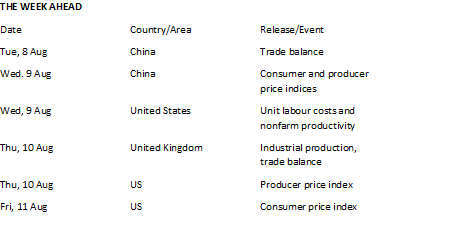
Week Ahead


All the Best and have a great week ahead

Stuart

CEO

Farringdon Group

+60 3 2026 0286