Market Outlook for 2013

2013-forecast-stuart yeomans

In terms of “Economic Commotions”, 2012 has been as important as 2008. In 2008, the breakdown of global capitalist system was triggered by the collapse of Lehman Brothers. Whereas in 2012, we have seen various creative actions from policymakers working hard “not” to fix but to delay economies from collapsing!

Are policymakers living in a “fantasy land” where the world economy will fix itself through the operations of the business cycle, and the “magic of the market” coming to the rescue? We are now into the fifth year of the financial crisis, and we have not – and are well away from – seeing a fix to the crisis! We are currently in an era where the financial system is being sustained only because of interventions by the world’s major central banks through an activity called “quantitative easing” – which simply means creating more money!

Policymakers fail to see that this method no longer creates conditions for recovery or increase in business activity, and they are simply financing accumulation of profits through speculation, in other words creating a bubble – the very same thing that led to the 2008 crash.

If pumping liquidity into the financial markets helps, why aren’t we seeing a recovery in unemployment numbers?

After a contraction of 0.5% in 2012, the euro area is expected to grow by at most only 0.3% in 2013 and 1.4% in 2014. In 2012 the US grew between 2 and 2.2%, however this is expected to fall to 1.7% in 2013. These figures are well below the levels experienced during every other “recovery” in the post-World War II period. Japan, whic

h had experienced a contraction last quarter, is expected to grow by only 0.6% in 2013, after growing by 1.5% in 2012. These are figures provided by the UN, and although the figures may vary a little, reports from all other major international financial institutions highlight the same trend.

These weak numbers were due to contracting world trades. In 2009, the world trade fell by 10%, but then rebounded significantly in 2010. However in 2011, the growth of exports started to slow and then decelerated sharply in 2012, mainly due to declining import demand in Europe and anaemic aggregate demand in the United States followed by Japan.

Most economists believed that the BRIC economies could provide a new base for the expansion of global capitalism, however falling growth rates in these economies has proved otherwise.  Last year, the growth rate in China dropped from 10.4% to 7.7%. Brazil, where growth reached 7.5% in 2010, recorded a rate of just 1.3% last year, while India’s growth has fallen from 8.9 to 5.5%.

In our point of view, the global businesses are being cynical towards the future due to previous financial crises and this is not allowing headway towards a recovery. This mindset has to change…further stimulus will only delay a recovery causing the bubble to expand.

Between 2007 and 2011, private investment in the 27-member European Union fell by more than €350 billion, larger than any previous decline in absolute terms. This represented more than 20 times the fall in private consumption and four times the decline in real gross domestic product. Private investment is now 15% lower than in 2007, meaning companies will not generate some €543 billion in revenues between 2009 and 2020 that they otherwise would have.

A recent report from McKinsey Global Institute noted that European companies had excess cash holdings of €750 billion for which they could not find profitable outlets. The piling up of cash points to a breakdown in the basic dynamic of capitalist production, in which investment leads to the accumulation of profit, which then results in further investment and economic expansion.

The US economy is suffering from the same mindset, where companies are piling up cash while profits are being accumulated through investor sentiments and speculation in financial markets rather than the technicality of the companies themselves i.e. the companies’ capability of generating more profits by increasing products and services.

In 2012, we have seen many measures from policymakers to spur growth, however none of these have brought a sign that we are in a recovery phase.  The current mindset has to change; private investment will need to increase to lead the economy towards a recovery. The worst mistake it could make is to believe that half-measures will suffice or that the capitalist economy will eventually right itself. Though growth in the Emerging Markets continued to remain positive through their domestic demands, they will eventually suffer a hard landing due to diminishing demands from developed markets.

Regional Outlook

UNITED STATES

The US economy will stay on a moderate growth path next year amid lacklustre consumer spending and weak business investment.

The US Federal Reserve has broadcast its intentions to continue increasing the overall size of its balance sheet in an attempt to stimulate the sluggish economy. The US federal funds rate, its main policy rate tool, remains at the exceptionally low level of zero to 0.25% and there are no expectations that it will shift in 2013. The Fed is on hold as far as the eye can see. We certainly don’t see the rates rising this year.

In early February we are ought to see another fiscal fiasco on the US debt ceiling. Should the Congress not take action to raise the country’s borrowing limit, the US will default on its debt. We believe the Republicans will not be willing to take the blame of forcing the US into defaulting it debts.

EUROPE

A Greek exit and deterioration in Spain are the currency union’s biggest short-term risks. Besides Greece, the focus will be on Spain – specifically, if or when it applies for a bailout package that would make it eligible for the Outright Monetary Transactions (OMT) introduced by the ECB. Further easing is expected, given recession in the euro area. The ECB has followed a Taylor rule over the last decade, taking into account not only inflation but also the business cycle status. Therefore, it is expected that the ECB’s monetary policy will be accommodative in the near future.

We’ve seen four consecutive quarters of negative GDP growth. We might see a 25-basis-point rate cut that could come in the first quarter of 2013, which would bring down the official policy rate to 0.50% from its current 0.75% level. But, additional monetary accommodation could be seen as well.

The ECB stands ready to step in with further assistance if market conditions warrant. The ECB has broadcast its willingness to buy government bonds on the open market through its so-called OMT program. Most analysts agree that a rate cut to 0.5% would mark the low point for the ECB in the current monetary policy easing cycle and then rates would be on hold for the remainder of 2013.

EMERGING MARKETS

In this interconnected world, what happens in the key economies of the US, Eurozone, and Japan this year will almost certainly impact the global economy at large, but the ebb and flow of action and reaction is shifting. Emerging markets, for instance, are generally lessening their trade dependence on the US and Europe, and there are other countries that can drive global growth—some of which may even surprise us in 2013. In addition, a likely continuation of easy monetary policies in the developed markets this year could result in more investment dollars into global equity markets including emerging and frontier markets.

Emerging markets in general have had three characteristics in their favour: generally high economic growth rates, large amounts of foreign reserves and low foreign debt. Many emerging economies appear to be on the cusp of consumer booms as well as productivity advances, which should bode well for future growth potential.

The middle class is growing in many emerging markets, and with it, the potential to fuel a consumer spending boom; the numbers in developing and Southeast Asia look particularly compelling to us. The latest estimates from the International Monetary Fund project developed economies as a whole to have achieved GDP growth of only 1.3% in 2012, with growth expected at 1.5% in 2013. In contrast, emerging Asia is expected to post an estimated GDP growth of 6.1% in 2012 and 6.8% in 2013.

CHINA

Following a year tainted by heightened economic uncertainty, the world’s second largest economy is setting itself up for a positive 2013. Supported by the slew of upbeat economic data and improving investor sentiment, the benchmark Shanghai Composite rallied almost 15% last month, pushing the market into positive territory for 2012.

Worries over possible overheating in the economy led Chinese policymakers to exercise caution with unleashing new stimulus to support growth in 2012. In September, Beijing approved over $150 billion in infrastructure spending – around one quarter of the total size of the stimulus package unveiled in 2008 to prop up the economy following the onset of the global financial crisis. Nonetheless, China’s economy has staged a recovery helped by a pickup in domestic demand, and is expected to grow in the 7.5%-8.5% range in 2013.

INDIA

After going through a gloomy phase in 2012, the Indian economy is poised to return to a healthy growth trajectory in the early part of 2013-14 on the back of some positive factors. While it may not be a smooth ride due to several risk factors going ahead, investors and economists say the worst may be over for the Indian economy.

Inflation, which has emerged as a major policy challenge for almost the past three years, is also expected to moderate in the months ahead and there is a consensus that it may settle in the 6-7% range by end-March 2013.

Perhaps the most crucial factor that should help jumpstart growth and boost investments as well as sentiment would be the easing of interest rates. The Reserve Bank of India has signaled its intent to support growth and expectations are that the central bank may cut policy rates in January.

I hope that you enjoyed reading

Warm regards

Stuart Yeomans 

CEO

Farringdon Group

Kuala Lumpur : Malaysia

What is Happening to Investment Bonds?

In our recent market outlook, we emphasized the objective that we do not aim to track a benchmark in the traditional sense and that our primary concern was that the portfolio should meet every investor’s desire to preserve capital. With markets remaining uncertain, we have continued to maintain a defensive approach by being biased towards bond funds and mixed asset funds (which have also been biased towards bonds). This approach has kept growth on our portfolios stable.

Determining an accurate outlook for the financial markets is never an easy task, however the 2013 bond market outlook is even more challenging than usual. While nearly all of the factors that helped bond market performance in the past two years remain firmly in place, bond yields are at extremely low levels compared to history. This indicates that yields have less room to fall (and by extension, for prices to rise) than was the case one or two years ago. At the same time, it leaves greater latitude for yields to rise which would in turn cause prices to fall if one or more elements of the fundamental backdrop were to change. The bond markets are therefore looking at one of two scenarios:

  • The investment environment improves or stays the same. In this case, the overall bond market would likely deliver returns within one to two percentage points of its yield in 2013.
  • The investment environment takes a turn for the worse. Under this scenario, bonds could have significant downside.

However, the primary question is determining the probabilities of these two outcomes. Though the first scenario is more likely than the second, investors will still need to be cautious that the balance of risk and reward now is much less favorable compared to previous years. Compared to equities, bonds can continue to provide safety, diversification, and modest levels of income – however the returns will not be the same as they were during the 2011-2012 periods.

In the last quarter of 2012, “iShares iBoxx $ InvesTop Investment Grade Corp. Bond Fund” offered a 30-day SEC annualized yield of 2.75%, while the largest high yield ETF, iShares iBoxx $ High Yield Corporate Bond Fund (HYG) yielded 5.76%. Both were still well above the 1.61% yield available on the 10-year U.S. Treasury note on that date. However, both are also near the low end of the historical range.

At the same period, the 30-day SEC yield on the iShares JPMorgan USD Emerging Markets Bond ETF had fallen to 3.3%, near the lowest in the history of the ETF. This indicates that investors aren’t getting paid nearly as much for the risks as they were one, two, or three years ago.

Although the risk-reward tradeoff has become less attractive, there are still a number of important positive factors that could hold back the major meltdown in the bond markets:

  • The U.S Federal Reserve has mentioned that it will not consider raising interest rates at least until unemployment reduces to 6.5% or inflation climbs beyond 2.5%, together with this the Fed is still employing its quantitative easing program. With the efforts from the Federal Reserve, seeing a major sell-off in US Treasuries is unlikely, except if we experience a significant decrease in unemployment figures or an increase in inflation, which will then benefit other asset classes.
  • Inflation remains low and we currently do not foresee any concern for inflation in the near term though there may be fears that the stimulative efforts from the Fed may increase prices.
  • Overall economic growth remains sluggish, and with higher taxes due for 2013, it is unlikely that it will grow above the 1-2% range. Should the economy experience stronger growth, the central bank will more likely raise interest rates which will hurt bond prices.
  • The “spread sectors” of the bond market – in other words, the non-Treasury segments that trade based on their “yield spread” (or advantage) over Treasuries – should continue to find support from investors’ search for higher-yielding alternatives to the safer areas of the market. This has been – and given the Fed’s low-rate policy – a positive factor supporting corporate, high yield, and emerging market bonds. At the same time, municipal bonds are likely to perform well in any environment since taxes are likely to go up no matter what the final outcome.

Though this factors may back the bond sector, there are several significant concerns that may prove otherwise:

  • Though the current level of inflation may be low; central banks across the globe have been pumping money into the global financial system in recent years. The simple reason this could cause inflation is that there is now more money in the system with the same amount of goods and services to purchase – which technically will drive prices up. As mentioned above, this is yet to happen due to sluggish growth; however when it does, Treasury yields will begin to climb in anticipation of tighter Fed policy, and the bull market in bonds will likely unravel.
  • The so called fiscal cliff has been resolved; however U.S. lawmakers still have to vote to raise the debt ceiling. Investors expect the issue to be resolved, as usual at the last minute, and any failure to do so would cause higher-risk assets to decline in price. But it would likely boost Treasuries and Treasury Inflation-Protected Securities (TIPS) while causing corporate, high yield, and emerging market bonds to lose ground. We should see how this issue gets resolved by the first quarter.
  • Besides this, there may be other unforeseen risk factors lingering around the bond sector that may cause a major pullback. Examples would be a sudden and surprising deterioration of the Chinese economy, a worst-case scenario emerging from the European debt crisis (such as a collapse of the Eurozone), or a severe downturn in the global equity markets. Typically, these types of issues benefit U.S. Treasuries but weigh heavily on higher-risk market segments such as high yield and emerging market bonds.

Both corporate and high yield bonds produced average annual total returns of 9.30% and 12.30%, respectively. With such high returns already in the rear-view mirror, it’s highly unlikely that corporate and high yield bonds can continue to deliver similarly robust performances in 2013. In addition, week-to-week volatility is likely to rise – a contrast from the relatively steady upward trend that characterized 2012.

As for emerging market bonds, even though the fundamentals in these regions are much stronger now than they were 10 or 15 years ago, emerging debt is still very sensitive to developments in the broader world economy. During the times when investors lose their appetite for risk, emerging market bonds will almost undoubtedly underperform. Factors that could derail the asset class in the year ahead include a worsening of the economic slowdown in the United States and/or China, a resurgence of the European debt crisis, or conflict in the Middle East, not to mention risks as yet unknown.

In recent years, we have seen a significant amount of cash moving out of stocks and into the bond sector. Yields are presently so low that it has now become technically impossible for bonds to replicate recent returns. Stocks currently offer investors attractive dividends and potential for capital gain, and if the economy sees an improvement, we will see capital being redirected from bonds to equities.

Following expectations of continued low yields, higher volatility and limited growth on the bonds, we have crystalized gains that were made throughout our bond funds. Proceeds from the sales will be reallocated into various mixed asset funds which has exposure to equities, bonds, currencies and are not limited to remain invested in a specific asset class.

I hope that you enjoyed reading

Warm regards

Stuart Yeomans 

CEO

Farringdon Group

Kuala Lumpur : Malaysia

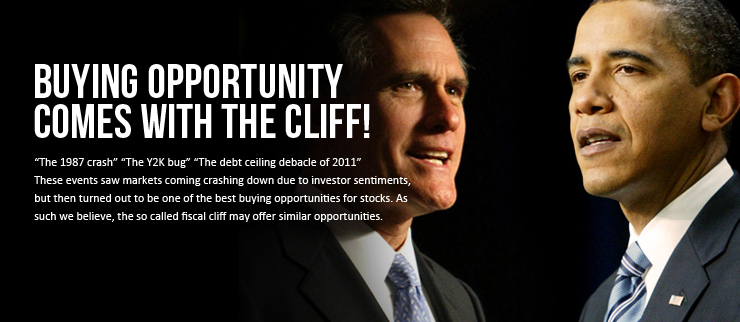
The Fiscal Cliff can and will offer buying opportunities!

“The 1987 crash” “The Y2K bug” “The debt ceiling debacle of 2011” These events saw markets coming crashing down due to investor sentiments, but then turned out to be one of the best buying opportunities for stocks. As such we believe, the so called fiscal cliff may offer similar opportunities.

The first round of budget talks had been stated by the House Speaker as being constructive. Obama later on came out to express confidence that he and the Congress would reach an agreement that will avoid the automatic spending cuts and tax increases that are scheduled to occur at the end of the year. With these statements we saw a temporary rise in the equity markets towards the end of the trading period for the week, though last week’s trading sent the Dow Jones to its longest losing streak since August 2011. Investor sentiments remain weak, however it suggest hope for a rally once outcome of the budget talks are released.


Stuart Yeomans Obama

The S&P has fallen by more than 5% since Obama’s re-election; however this pessimism is a result of investor’s sentiment rather than technicality. It doesn’t really sound right to wake up the day after an election and realize that the economy will suffer from a “fiscal cliff”. The phrase “fiscal cliff” is now part of the American lexicon, describing the looming deadline when tax cuts expire and spending cuts kick in at the end of 2012, when the terms of the Budget Control Act of 2011 are scheduled to go into effect.

Among the laws set to change at midnight on December 31, 2012, are the end of last year’s temporary payroll tax cuts (resulting in a 2% tax increase for workers), the end of certain tax breaks for businesses, shifts in the alternative minimum tax that would take a larger bite, the end of the tax cuts from 2001-2003, and the beginning of taxes related to President Obama’s health care law. At the same time, the spending cuts agreed upon as part of the debt ceiling deal of 2011 will begin to go into effect. According to Barron’s, over 1,000 government programs – including the defence budget and Medicare are in line for “deep, automatic cuts.”

In dealing with the fiscal cliff, U.S. lawmakers have a choice among three options; they can let the current policy scheduled for the beginning of 2013 – which features a number of tax increases and spending cuts that are expected to weigh heavily on growth and possibly drive the economy back into a recession – go into effect. The plus side: the deficit, as a percentage of GDP, would be cut in half.

They can cancel some or all of the scheduled tax increases and spending cuts, which would add to the deficit and increase the odds that the United States could face a crisis similar to that which is occurring in Europe. The flip side of this, of course, is that the United States’ debt will continue to grow.

They could take a middle course, opting for an approach that would address the budget issues to a limited extent, but that would have a more modest impact on growth.

None of this looks attractive!

The debate over how to solve the fiscal cliff may be more productive than is commonly recognized, as markets have considered all of the above. Hikes on capital gains and dividend taxes are on the line, and Obama has dug in his heels on what he sees as a mandate to make the tax code more progressive. He seems to have the upper hand in dealings with Congress because Republican lawmakers don’t want to see tax rates increase, which is what will happen if no solution is found by the beginning of 2013.

Republicans don’t want to take the blame for driving the economy over the cliff. The current crisis is similar to last year’s fight to raise the US debt ceiling, which led to the downgrade of the United States’ top credit rating in early August 2011. During the dealings, the S&P 500 lost 18.8% between its peak in July 2011 and its bottom in August. As the market slid, the political standoff badly hurt investors’ confidence in Washington, setting off a spike in volatility.

In the end a deal was announced that raised the ceiling and put off longer-term fiscal decisions until Jan 1, 2013, setting the stage for today’s “fiscal cliff” crisis.

After staying flat through September 2011, the S&P 500 jumped 31% between its October low and the end of March. The recent selling took the S&P 500’s relative strength index – a technical measure of internal strength – below 30 this week, indicating the benchmark is oversold and due for a rebound.

Volatility is expected to rise through the end of November and to spike in late December if no agreement on the fiscal cliff is reached in Congress. Alongside comes opportunity for those with high risk tolerance. However with both Obama and the Congress being happy with the first round of discussion we believe, markets are in for a yearend rally!

I hope that you enjoyed reading

Warm regards


Stuart Yeomans 

CEO

Farringdon Group

Kuala Lumpur : Malaysia


November Global Update

Real Gross Domestic Product – the output of goods and services produced by labour and property located in the United Sates – increased at an annual rate of 2% in the third quarter of 2012, which is better than forecasted. In the second quarter, real GDP increased by 1.3%. The growth probably picked up in the third quarter following stronger consumer spending, an improving housing sector and increased defense spending. Though the figures that were released are better than expected, this would be the first time back to back figures have never exceeded 2% since the US emerged from the recession in 2009. The improving housing market has helped in boosting household confidence whilst companies have cut back on replacing outdated equipment on concerns of the so called “fiscal cliff”. Most analysts believe that the economy is going through a slow and stable recovery and consumers are regaining confidence; however business spending continues to be a concern. Consumer spending grew to a 2% annual rate over the last quarter compared to an annual growth of 1.5% in the second quarter of 2012. Retail sales in September and August had the best back to back showing since late 2010 as shoppers purchased goods from cars to iPhones; a sign that demand was heading towards the year-end holiday season high. Cars and light trucks sold at an annual rate of 14.9 million in September, the highest since March 2008.

Decreasing unemployment and strengthening home prices should mean that consumer confidence will continue to increase. Nonfarm payrolls rose in September by 114,000 compared to an increase of 142,000 the previous month, and analysts estimate the nonfarm payroll for October to be at 125,000. The steep increase in payrolls in August was believed to be from seasonal employment. The unemployment rate fell to a 3 year low of 7.8% in September from 8.1% and is expected to be at 7.9% in October. Employment and the economy has been the central theme in the campaigns of President Barack Obama and Republican challenger Mitt Romney ahead of the November 6th presidential election. No US president since World War II has faced re-election with unemployment over 8% and an unemployment rate of 7.8% has been the lowest since President Obama took office in 2009. The US stock market have been closed for the last two trading days in October due to hurricane Sandy and is expected to resume trading on the 1st of October; this has been the longest weather-related shutdown in more than a century. The presidential campaigns have been disrupted and both candidates and their running mates have tempered their campaigns, eager not to appear out of sync with more immediate worries over flooding, power outages, economic calamity and personal safety.

In the UK, GDP rose by 0.6% compared to the previous three months. The surge masks underlying weakness in the economy that may still prompt more stimulus from the Bank of England. As policy makers are still divided on the need for more bond purchases when the current round ends in November, a few have said there is “considerable scope” to add to the so called quantitative easing. Even with additional positive signs of late, the economy remains weak, while large downside risks particularly around the euro-area situation continue to harm. Most of the Bank of England members may still support at least some loosening of the monetary policy. However, some officials have different views on the need of more quantitative easing, with some of the nine Monetary Policy Committee members questioning its potential impact. Reports released on the 9th October by the National Institute of Economics and Social Research showed that the economy grew by 0.8% and between 0.2% and 0.3% after deducting distortions. On the other hand, estimates in the Bloomberg GDP survey ranged from no change to an increase of 0.8%. Recently released data gave a boost to the outlook, with inflation easing, unemployment falling and retail sales rising more than forecast. Consumer price growth eased to 2.2% in September, the slowest in almost 3 years, while retail sales increased by 0.6%. The labor-market report showed that payrolls rose to a record in the quarter through August, pushing the unemployment rate down to 7.9% from 8.1%.

In Europe, reports showed that Spain’s recession extended into the third quarter while inflation has stayed high in October. This signals that its government’s austerity programme to cut public deficit is also increasing living expenses. GDP in Spain shrank 0.3% quarter on quarter between July and September marking the fifth consecutive quarter of contraction. The reading was however slightly better, as economists forecasted a fall of 0.4%. On an annual basis, the economy has shrunk by 1.6% and is still in line to meet its end of the year GDP target. Spain’s conservatives, who have been in power since December, have laid out spending cuts and tax hikes worth over 60 billion Euros to the end of 2014 to cut the budget gap within EU guidelines. This measurement includes an across the board increase of the VAT rate, in force since 1st September, which has pushed up consumer prices and hit sentiment on the high street. Retail sales have fallen at the sharpest pace on record since September as shoppers who are already cash-strapped shielded away from purchases after the price hike. The Eurozone’s fourth largest economy is at the centre of the bloc’s debt crisis on concerns that the government cannot control its finances. Spain’s refinancing costs on international debt markets soared to a euro-era high in July but have since eased after the European Central Bank said it would activate a sovereign bond buying programme for countries that ask for European aid. Spain has however refrained from asking for aid in fear of austerity measures it would have to further suffer.

In Asia, export-oriented countries such as Korea, Taiwan and Japan, have been quite significantly affected by the recession in Europe, lacklustre growth in the US and a slowing China. While the export sector in ASEAN has been losing momentum in recent months (particularly commodity exports from Malaysia and Indonesia), their economic growth, surprisingly, has remained strong. Indonesia, the Philippines, Malaysia and Thailand grew at 6.4%, 5.9%, 5.4% and 4.2% year-on-year, respectively, in real terms in 2Q 2012. The weighted average real GDP growth for the ASEAN-51 was 5.0% in 2Q, still above the 18-year average of 4.7%. During this period, the growth of other Emerging Markets weakened to below the long-term mean. Therefore, the relative economic performance of ASEAN is really quite impressive. In China, government policy has been incrementally supportive for economic growth since the second quarter of this year, with moderate monetary and fiscal policy announcements. Exports, a key drag to economic growth, have slowed to a 3-year low to 1% in July. In mid-September, a string of policies were announced by Beijing to stabilize growth, including speeding up the export tax rebate, expanding financial support for exporters and simplifying custom procedures. Overall economic growth is expected to see signs of improvement entering into the fourth quarter as there came broader improving data points across housing starts, auto production and infrastructure construction. Chinese residential property continues to enjoy a recovery with new home sales growth maintaining a 13.3% year-on-year, after a 14.5% rise in July. That ended a run of nine consecutive months of negative year-on-year sales numbers. Stronger sales last month led to stronger residential investments, which are anticipated to continue going forward. Investment in residential property returned to 10.6% year-to-date. We have continued to maintain a risk adverse approach by minimizing exposure to aggressive equity markets and volatile commodities. Should there be a rally our portfolios are positioned to benefit through our US Equity funds and Mixed Asset funds which are moderately exposed to global equities.

I hope that you have enjoyed reading this post.

Stuart Yeomans 

CEO

Farringdon Group

Kuala Lumpur : Malaysia

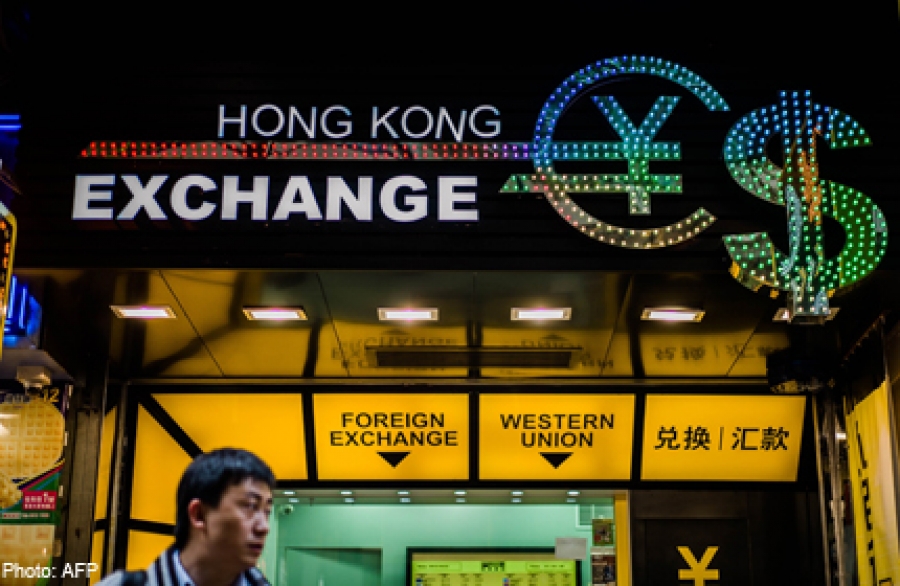
Hong Kong Monetary Authority Intervene in Currency Markets

Hong Kong’s Monetary Authority (HKMA) has intervened in the currency markets for the third time in less than a week, selling a total of HK$6.63bn (US$855m) to halt the rise of the Hong Kong dollar against the US dollar.

Hong Kong currency pushes up against the upper limits of its trading band of US$1 to HK$7.75

The mechanisms that govern Hong Kong’s currency board, by which the Hong Kong dollar’s exchange rate is linked to the US dollar, mean that the central bank must buy US dollars when the Hong Kong currency pushes up against the upper limits of its trading band of US$1 to HK$7.75.

In an attempt to halt appreciation of the local currency after it hit HK$7.75, the lower limit of its trading band to the U.S. dollar. The HKMA started selling Hong Kong dollars in the foreign exchange markets on October 19 2012. This was the first of such a move, the central bank had made since December 2009.

The link of the Hong Kong dollar to the US dollar was put in place in 1983 when negotiations about the future of the British colony after 1997 had sparked nervousness in the local business community.

In 2005 Hong Kong committed to keep the exchange rate between HK$7.75 and HK$7.85. The link has given Hong Kong companies stability in commercial contracts while tethering monetary policy to that of the U.S., where borrowing costs are being held down to spur hiring and prop up the housing market. Hong Kong’s jobless rate is near a four-year low and home prices are at all-time highs, as Bloomberg reports.

Property prices in Hong Kong are among the highest in the world as local and mainland Chinese investors have rushed to buy apartments in the city as a hedge against inflation.

‘The city had $301.2 billion of foreign-exchange reserves as of the end of September, amounting to about eight times the currency in circulation. The holdings grew 8.5 percent in the past year’, Bloomberg reports.

According to Bloomberg, the analysts said that the strong inflow of money into Asian currencies and stock markets has been prompted by increasing investor appetite for emerging markets as they sought better returns. In a recent note to clients, HSBC said that the more “equity-oriented” currencies such as the Indian rupee, the Korean won and the Taiwanese dollar had outperformed as money had flowed into local stock markets.

The recent strength in the Hong Kong dollar against the US dollar was in line with other Asian currencies because the US. Federal Reserve’s quantitative easing measures had also weakened its own currency. Stella Lee, president of Success Futures & Foreign Exchange Ltd. in Hong Kong, said to Bloomberg by telephone that “there could be more intervention” in Hong Kong.

According to the Financial Times, over the past couple of years, the fact that the dollar peg allows the local central bank little latitude to curb asset price inflation in the city through raising interest rates, for example, has led to calls from HKMA’s previous Chief Executive Joseph Yam, to reconsider the currency mechanism. ANZ said that it remained confident that the system would stay in place for the foreseeable future. “The intervention suggests that the HKMA will continue to defend the HKD peg,” it said. “The currency reserve is sufficiently strong to defend against not only normal capital flow but also speculative pressure . . . The HKMA intervention and recent strength of the HKD will probably be temporary and successful.”

Government officials, however, have stressed that the linked exchange rate serves the city well by giving the financial centre the stability it needs. The lack of convertibility of the Chinese renminbi also makes it an unlikely currency for the Hong Kong dollar to be linked to despite the strong economic ties between China and Hong Kong.

 I hope that you have enjoyed reading this post.

Stuart Yeomans 

CEO

Farringdon Group

Kuala Lumpur : Malaysia

Malaysia’s confidence in withstanding capital in-flows

As Asian nations take the necessary steps to prevent asset bubbles after the U.S. boosted stimulus, Central Bank Governor Zeti Akhtar Aziz has reassured the Malaysian community by saying that;

 ‘Malaysia can manage capital inflows due to monetary easing in advanced economies.’

Governor Zeti, speaking with confidence

Zeti who oversaw the Malaysian response to capital outflows during the Asian financial crisis more than a decade ago, also said;

‘The country has the tools and flexibility to absorb any excess liquidity.’

Zeti spoke confidently and this is because of the good news that the Malaysian economy is withstanding the impact of weakening global growth, with the gross domestic product forecast to expand about 5 percent this year.

The Malaysian Ringgit is also very strong; I personally remember the currency being over seven Ringitt to just one pound sterling around 5 years back. We are now looking at a conversion rate of around RM4.9 to GBP1.

Due to the Malaysian financial system reaching new levels of maturity in terms of development and its functioning, the cash flows that Malaysia are in receipt of, can be intermediated.

This is in regards to both surges of inflows and reversals. All these effects are disbursed through the financial system rather than concentrated.

Malaysia are not the only country confident of this; Brazil has also signaled confidence that it can counter any surge in flow stemming from the U.S Federal Reserves QE3.

I hope that you have enjoyed reading this post.

Stuart Yeomans 

CEO

Farringdon Group

Kuala Lumpur : Malaysia