Summary of The UK’s Budget 2017


I have highlighted the points that may affect people

Stamp duty and housing

  • Stamp duty to be abolished immediately for first-time buyers purchasing properties worth up to £300,000
  • To help those in London and other expensive areas, the first £300,000 of the cost of a £500,000 purchase by all first-time buyers will be exempt from stamp duty, with the remaining £200,000 incurring 5%.
  • 95% of all first-time buyers will benefit, with 80% not paying stamp duty
  • Reduction will apply immediately in England, Wales and Northern Ireland although the Welsh government will have to decide whether to continue it when stamp duty is devolved in April 2018
  • It will not apply in Scotland unless Scottish government decides to follow suit
  • £44bn in overall government support for housing to meet target of building 300,000 new homes a year by the middle of the next decade
  • Councils given powers to charge 100% council tax premium on empty properties
  • Compulsory purchase of land banked by developers for financial reasons
  • £400m to regenerate housing estates and £1.1bn to unlock strategic sites for development
  • Review into delays in developments given planning permission being taken forward
  • £28m for Kensington and Chelsea council to provide counselling services and mental health support for victims of the Grenfell fire and for regeneration of surrounding area
  • New homelessness task force


Alcohol, tobacco and fuel

  • Tobacco will continue to rise by 2% above Retail Price Index (RPI) inflation, equivalent to 28p on a pack of 20, while the minimum excise duty on cigarettes introduced in March will also rise
  • Duty on hand-rolling tobacco will increase by additional 1%
  • Duty on beer, wine, spirits and most ciders will be frozen, equating to 1p off a pint of beer and 6p of a typical bottle of wine
  • But duty on high-strength “white ciders” to be increased in 2019 via new legislation
  • Fuel duty rise for petrol and diesel cars scheduled for April 2018 scrapped
  • Vehicle excise duty for cars, vans and motorcycles registered before April 2017 to rise by inflation
  • Vehicle excise duty for new diesel cars not meeting latest standards to rise by one band in April 2018
  • Tax hike will not apply to van owners
  • Existing diesel supplement in company car tax to rise by 1%
  • Proceeds to fund a new £220m clean air fund for pollution hotspots in England


The state of the economy

  • Growth forecast for 2017 slashed from 2% to 1.5%
  • Forecasts for 2018, 2019, 2020 and 2021 revised down to 1.4%, 1.3%, 1.5% and 1.6% respectively.
  • Productivity growth revised down by an average of 0.7% a year up to 2023
  • Annual rate of CPI inflation forecast to fall from peak of 3% towards 2% target later this year
  • Another 600,000 people forecast to be in work by 2022
  • £3bn to be set aside over next two years to prepare UK for every possible outcome as UK leaves EU


The state of the public finances

  • Annual government borrowing £49.9bn this year, £8.4bn lower than forecast in March
  • Borrowing forecast to fall in real terms in the subsequent five years from £39.5bn in 2018-19 to £25.6bn in 2022-23.
  • But projected borrowing has been revised up for 2019-2020, 2020-2021 and 2021-22, compared to March, due to the weaker economic outlook and expected lower tax yields
  • Public sector net borrowing forecast to fall from 3.8% of GDP last year to 2.4% this year, then 1.9%, 1.6%, 1.5% and 1.3% in subsequent years, reaching 1.1% in 2022-23.
  • Debt will peak at 86.5% of GDP this year, then fall to 86.4% next year; then 86.1%, 83.1% and 79.3% in subsequent years, reaching 79.1% in 2022-23.


Welfare and pensions

  • £1.5bn package to “address concerns” about the delivery of universal credit
  • Seven-day initial waiting period for processing of claims to be scrapped
  • Claimants to get 100% advance payments within five days of applying from January
  • Typical first payment will take five weeks rather than current six
  • Repayment period for advances to increase from six to 12 months.
  • New universal credit claimants in receipt of housing benefit to continue to receive it for two weeks


Business and digital

  • VAT threshold for small business to remain at £85,000 for two years
  • £500m support for 5G mobile networks, full fibre broadband and artificial intelligence
  • £540m to support the growth of electric cars, including more charging points
  • A further £2.3bn allocated for investment in research and development
  • Rises in business rates to be pegged to CPI measure of inflation, not higher RPI, a cut of £2.3bn
  • Digital economy royalties relating to UK sales which are paid to a low-tax jurisdiction to be subject to income tax as part of tax avoidance clampdown. Expected to raise about £200m a year
  • Capital gains tax relief for overseas buyers of UK commercial property to be phased out, with exemptions for foreign pension funds
  • Charges on single-use plastic items to be looked at
  • £30m to develop digital skills distance learning courses


Education and health (England only)

  • £40m teacher training fund for underperforming schools in England. Worth £1,000 per teacher
  • 8,000 new computer science teachers to be recruited at cost of £84m and new National Centre for Computing to be set up
  • Secondary schools and sixth-form colleges to get £600 for each additional pupil taking maths or further maths at A-level and core maths at an expected cost of £177m
  • £2.8bn in extra funding for the NHS in England
  • £350m immediately to address pressures this winter, £1.6bn for 2018-19 and the remainder in 2019-20
  • £10bn capital investment fund for hospitals up to 2022
  • No extra funding for nurses pay but a guarantee that if future pay rises are recommended by independent body, there will be new money


Nations/infrastructure/transport/regions/science

  • £320m to be invested in former Redcar steelworks site
  • Further devolution of powers to Greater Manchester
  • £1.7bn city region transport fund, to be shared between six regions with elected mayors and other areas
  • £30m to improve mobile and digital connectivity on TransPennine rail route.
  • £2bn for Scottish government, £1.2bn for Welsh government and £650m for Northern Ireland executive
  • Scottish police and fire services to get refunds on VAT from April 2018
  • Young person’s railcard extended to 26-30-year-olds, giving a third off rail fares


Have a good day

All the best

Stuart

CEO

Farringdon Group

+60 3 2026 0286

UK Expat Issues – Residency, Domicile & Tax


As you have seen in the news lately things are changing in the UK not only to combat money leaving the UK but to also combat tax evasion. There is a misconception that tax avoidance is the same as Tax evasion, it’s not.


Definition of Tax Evasion

“Income tax fraud is the wilful attempt to evade tax law or defraud. Tax fraud occurs when a person or a company does any of the following: Intentionally fails to file a income tax return. Wilfully fails to pay taxes due. … Makes fraudulent or false claims”


Definition of Tax Efficiency

“Tax efficiency is an attempt to minimize tax liability when given many different financial decisions. … Other options to reduce tax liability include taxefficient mutual funds, irrevocable trusts and tax-exempt commercial paper”


So, this is where things get interesting for all UK Expats as things get complicated, VERY COMPLICATED!


Take a look at the below Fact Sheet and have a think about what you will be doing, not now, but in a few years, will you go back to the UK to retire because of the NHS, because of family, most do believe it or not and then forget about everything, until it’s too late.


Legislation Changes

  • Legislation changes impacting on UK Expats , Non-UK residents with residential property and future UK resident

Are you:

  • Were born in the UK?
  • Frequently visit the UK and have ties to the UK?
  • Have residential property in the UK?
  • Plan to live in the UK but not born there?
  • Planned to return as a ‘Non Dom’?


UK Residency

As you live overseas and pay the jurisdictions taxes you live in you become a ‘tax resident’, this is not the same as ‘Resident’

We see this on many occasions and unfortunately people just DON’T know the correct way to calculate this

We hear;

I am not UK resident, I only spend the summer holidays there’ BUT,

  • If more than 16 days you CAN be UK resident


*Must look at number of days and ties to the UK to determine residence and exposure to the tax system


Residency, the Basics


For a UK tax liability to arise;

  1. HMRC use: The ‘Theme of ‘connecting factors to UK’ which means that there:
  2. Must be a UK source for the Income/Capital Gain

or

  1. Person must be UK resident


Historic UK Residency

This can be used but only for guidance as this is historical and reasonably ambiguous and things change

IR20………

Then

HMRC6


UK Residence Developments

The developments were brought in 2013 and without much advertising so previously were you could go by the 90 day rule these have been brought in;

  • Statutory Residence Test enables the tax payer to have more certainty since April 2013
  • Test based on connecting factors
  • Concept of ‘Ordinarily resident’ no longer used


Connecting factors – Residence

This has now become a 3 part test called ‘Connecting Factors’, where you are able to confirm/test your residency

  • Part A contains rules which if met confirm that the individual is non-UK resident
  • Part B has rules where if met a person would be considered to be UK resident
  • If neither Part A nor Part B apply, Part C looks at ‘connecting factors’ for tax purposes – too many and person could remain UK resident
  • Most UK expats will have ‘connecting factors’ to the UK, this is where planning is required


Statutory Residence Test 1

  • Part A of the test will conclusively determine that an individual is not resident in the UK for a tax year if they fall under any of the following conditions, namely they:
  • Were not resident in the UK in all of the previous three tax years and they are present in the UK for fewer than 45 days in the current tax year; or
  • Were resident in the UK in one or more of the previous three tax years and they are present in the UK for fewer than 16 days in the current tax year; or
  • Leave the UK to carry out full-time work abroad, provided they are present in the UK for fewer than 91 days in the tax year and no more than 31 days are spent working in the UK in the tax year


Statutory Residence Test 2

  • If Part A of the test does not apply, an individual will be conclusively resident for the tax year under Part B if they meet any of the following conditions, namely they:
  • Are present in the UK for 183 days or more in the current tax year; or
  • Have only one home and that home is in the UK (or have two or more homes and all of these are in the UK); or
  • Carry out full-time work in the UK


Statutory Residence Test 3

  • Where neither Part A or Part B apply conclusively, then the factors of Part C are used as the


‘Tie Breaker’


Tie breaker – Connecting Factors

  • Connecting Factors are:

– Family (defined as spouse, civil partner, common law partner and minor children) resident in the UK

– Available accommodation in the UK

– Working in the UK for 40 days or more days per tax year (working 3 or more hours a day constitutes a working day)

– Spending 91 days or more in the UK in either of the last two tax years

– Spending more time in the UK than any other single country

  • Also depends on whether you are an ‘Arriver’ or a ‘Leaver’


Connecting Factors – How Many Are Required?



Case Study – Arriver

Mr D is a businessman with homes in various countries. He has not been resident in the UK prior to 2015-16. He has business interests in the UK and owns a house in London but, until 2015-16, he spends only a few days in the UK each year. In 2015-16 his wife moves to the UK to live in the London house with their two children. His wife and children become resident in the UK.

The children enrol in local schools and Mr D visits whenever he can. He spends 95 days in the UK in 2015, 45 of them working. He stays in the London house on days when he is in the UK.

Decision:

Mr D is resident in 2015-16 under Part C of the test. This is because he spends 91 days or more in the UK and has 3 connecting factors:

  1. A UK resident family;
  2. Accessible accommodation in the UK; and
  3. Substantive UK employment


Case Study – Leaver

Mrs E has been UK resident for several years, always spending more than 250 days per year in the UK. She has a successful IT company and now decides to create a new branch of the business in South Africa.

In 2015-16 she buys a house in Cape Town and spends a large amount of her time there. Until the new branch is established her family will remain resident in the UK and continue to live in the family home. She commutes back to the UK when she can, staying with her family when she does. She is in the UK for 93 days.

Decision:

In 2015-16 Mrs E is resident in the UK under Part C as she spends 90 days or more in the UK and has 3 connecting factors:

  1. A UK resident family; and
  2. Accessible accommodation in the UK; and
  3. Spent 91 days or more in the UK in the previous tax year.


Residence – Summary

  • Plan to be challenged , keep evidence of arrival/departure
  • Don’t simply rely upon ‘day counting’
  • If claiming non-residence be aware of ‘everyday’ connections
  • If you are UK resident, you are subject to tax on your worldwide income and gains
  • Losing UK residence status is not as easy as you think, retaining it can be easier.
  • HMRC is interested in everybody, not just ‘high profile’


  • Care using UK as a ‘correspondence address’ OECD common reporting standards.


What is Domicile?

  • Generally ; The country that the person treats as their permanent home,  or lives in and has a substantial connection with
  • You cannot be without a domicile
  • You can only have one domicile at a time
  • You are normally regarded as domiciled in the country where you have your permanent home.
  • Your existing domicile will continue until you acquire a new one


UK Domicile

We hear ‘I don’t have a problem, I was born in the UK but I’m Non-Dom now’ so often when trying to assist UK Expats, so:

  • Born in the UK = UK domicile of origin
  • Can be lost, but difficult and open to challenge (Barlow Clowes v Henwood)
  • If you move to another country , you revert back to your domicile of origin
  • If retained on death, exposure to all UK taxes on worldwide assets


Your domicile is distinct from your nationality, citizenship and your residence status, although these can have an impact on your domicile


UK Domicile/IHT Rules

General

  • Nil rate band of £325,000 each
  • Transfers on death between UK Dom Exempt from IHT
  • UK Dom/Non-Dom , only up to £325,000 (after NRB)
  • Election can be made to be UK Dom following death of UK Dom spouse but…. 2 year limit and residence requirement
  • Although all assets free of IHT following election, will remain UK Dom for next 4 years, even if UK Domicile renounced and leave the UK.
  • 15/20 rule for deemed domicile


Legislation Updates – UK Domicile Rules


Retrospective from April 2017

  • If born in the UK & return to UK = immediate return to UK Dom
  • If born in the UK, retain UK Dom for 4 years after leaving
  • If acquiring UK domicile of choice, election remains for 4 years
  • ‘Lifelong’ non-domicile status to end
  • New 15/20 Deemed Dom Rule
  • UK property held through Offshore Company looked through
  • Remittance basis cannot be claimed once UK Dom
  • Asset value can be rebased to April 2017 value
  • Domicile ruling is in respect of all taxes, not just IHT.


Inheritance Tax & Domicile


  • 40% tax charge on value of estate above £325,000
  • Gifts between UK Dom spouses /civil partners exempt
  • Care required where Non-Dom spouse / civil partner


Individuals with a UK domicile of origin who planned to return to the UK as a Non-Dom must review their planning


Inheritance tax & Domicile

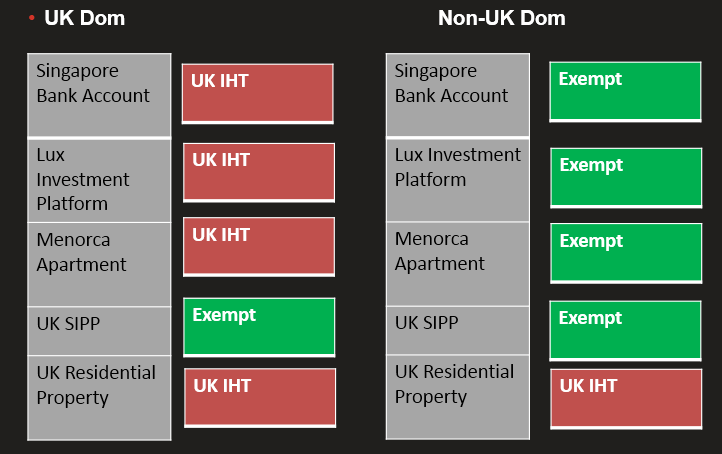
John has lived outside of the UK for the last 15 years working as an IT contractor and has the following assets in his estate:

Singapore Bank Account £250,000

Luxembourg Investment Platform £150,000

Apartment in Menorca £175,000

UK SIPP £100,000

UK residential property £200,000


What is his UK IHT Exposure if he returns?


Do You Have Residential Property in the UK?

  • IHT Irrespective of domicile/residence status
  • Ownership through a Company no longer provides protection
  • How will HMRC know?
  • Checks will be made when property is to be transferred as to whether property has ever been included in IHT valuation
  • Options – Insure against Liability sell or change to PPR?
  • If selling, was valuation obtained April 2015 for CGT?


UK Residential Property

  • ATED provisions in place since 2013 for HVRP that is ‘Enveloped’
  • ATED allowed charge to be paid to continue to avoid SDLT & IHT
  • IHT protection lost on all UKRP irrespective of value
  • IHT liability is the value of the ‘structure’ that relates to the UKRP
  • Debts can be offset against the value but loans between connected parties can not
  • Is there any point in paying this charge if no IHT benefits?


IHT and the Family Home

This is another we hear a lot ‘We don’t need any planning, we have a £1m IHT allowance’, wrong !

Restrictions

  • If you do not own a residential property, there is no £1m threshold!
  • There will be a tapered withdrawal of the additional nil-rate band for Estates (not the property)
  • With a net value of more than £2 million. This will be at a withdrawal rate of £1 for every £2 over this threshold.

More Restrictions….

  • It will not apply to reduce the tax payable on lifetime transfers that are chargeable as a result of death (UK Dom to Non Dom)
  • A property which was never a residence of the deceased, such as a buy-to-let property, will not qualify.
  • If property value is less than allowance, balance can’t be used to offset IHT on other assets

Even More Restrictions….

  • A person who dies with no direct descendants will not be able to benefit
  • Not restricted to UK properties only however, the property must be within the scope of UK IHT and included in the deceased’s estate.
  • Cannot be claimed by Non-UK Doms unless the home is in the UK


Non-Dom Planning

  • Jane is John’s wife, she also works in IT and will be moving back to the UK with him. She was not born in the UK however, it’s highly likely they she will be deemed domicile in the future. She is concerned that the wealth that has been accumulated is going to be eroded by the UK tax system. She requires access to her capital and isn’t keen on paying the remittance basis charge.

She has the following assets:

  • Non UK Bank accounts                                  £450,000
  • Non UK Stock Portfolio                                 £275,000
  • Non UK Investment Platform                      £300,000


UK Tax Exposure?


What is the remittance basis tax charge?

Annual tax charge to prevent non-UK source income and gains from being taxed. Only applies to Non-Doms.

    First 7 years                        £0

7 / 9 Years                           £30,000

12 / 14 Years                       £60,000

17 / 20 Years                       £90,000


Under new legislation more than 15 Years all assets will taxable as deemed UK domicile


Non-Dom – Moving to the UK

This is what you will have to pay:
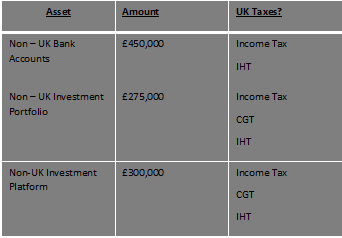


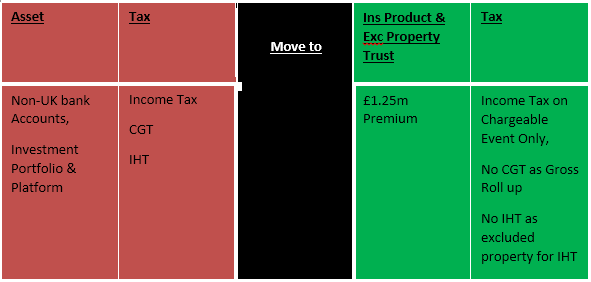
By Using Isle Of Man Insurance Product and Trusts


Excluded Property Trust

Planning Objective

  • IHT mitigation , access to trust fund
  • Generally used by those who:
  • Are currently non-UK domiciled but who may become UK domiciled in the future
  • Want to ensure that post April 2017 rules do not impact planning
  • How does it work?
  • Assignment of Non-UK situs property (IOM Insurance Product) to trust
  • Person who creates trusts has unrestricted access
  • As trust fund created prior to UK Dom, not taken into account for IHT


IHT Planning – Excluded Property Trusts



UK Tax Treatment on Creation

  • N/A , on creation as Settlor is not UK domiciled therefore, property is ‘excluded’ from IHT
  • Where Insurance product used, CGT protection and IT deferral

Restrictions

  • Must be certain of domicile status
  • Must only contain non-UK situs assets


UK -Dom Planning Post April 2017

What can John do?

  • He returns to his UK domicile of origin as soon as the residency test met
  • Cannot claim the remittance basis of taxation
  • His corporate structures holding properties are looked through for IHT
  • All non UK source income & gains are taxable in the UK
  • Worldwide estate is subject to IHT


Popular Planning using Tax Efficient Investment

Accepted non-offensive IHT Planning?

  • Mostly Trust based Insurance Co’s investment products that facilitate

– IHT mitigation through Outright Gifts

– IHT effective Loans/Asset Freezing

– Immediately Discounted Gifts


Importantly, these structures ARE recognised by HMRC as legitimate tax planning and are not caught by any Anti-Avoidance legislation


We cannot stress enough that the correct Estate Planning, Tax Planning, Succession Planning, call it what you will is vitally important and does not have to cost as much as you think, we can look at your current situation and gauge the best way forward, don’t leave it and think it’s OK. Also using UK based advisers or lawyers can also not work too well, give us 15-20 minutes of your time and let us plan your future correctly with no obligation.


Have a good day

All the best

Stuart

CEO

Farringdon Group

+60 3 2026 0286


Week 45 In Review – Tax Plans In Flux


  • Congress reworking tax proposals
  • Trump inks China trade deals
  • Saudi corruption probe, regional tensions boost oil
  • NY Fed chief announces retirement
  • China central bank head voices qualms over high leverage


Global equities reached all-time highs at midweek before backing off slightly ahead of the weekend. Yields on US 10-year Treasury notes rose modestly, trading at 2.38% Friday morning versus 2.34% a week ago. Oil gained ground amid uncertainty surrounding Saudi Arabia and Venezuela, climbing to $57.20 per barrel from $54.60 last week. Volatility, as measured by the Chicago Board Options Exchange Volatility Index (VIX), rose to 11.11 from 9.5 last week.


MACRO NEWS

US House and Senate offer differing tax plans
The US House Ways and Means Committee, the tax-writing arm of the lower house, amended the tax reform proposal it put forth last week. The Senate Finance Committee unveiled its plan for the first time on Thursday. Among the key differences the two bodies will need to iron out is the effective date of the proposed corporate tax cut from 35% to 20%. In the House bill, the cut would go into effect next year, while the Senate’s plan calls for the cut to become effective in 2019. GOP leaders are under intense pressure to pass a tax bill before the end of the year after failing to enact any major initiatives during the Trump administration’s first year in office.


Trade deals unveiled during Trump China visit
According to the White House, $250 billion in trade deals were agreed during US president Donald Trump’s visit to Beijing. Skeptics noted many of the announced deals were not contractual obligations and some may have been agreed previously. Despite the skepticism, some Chinese trade barriers appear to have been lowered, notably on the importation of US beef, which was halted in 2003 as a result of a BSE (mad-cow disease) scare in 2003.


Oil prices rise to two-and-a-half-year highs
Saudi Arabia’s crackdown on corruption, growing tensions between Iran and Saudi Arabia and the potential for a Venezuelan debt default all helped push oil prices higher this week. While short-term factors could push prices up in the near term, spare US production capacity could come back on line quite quickly, analysts say, limiting the market’s upside over the medium term.


NY Fed seeks new leader amid central bank turnover
The US Federal Reserve will have all-new leadership before long as Janet Yellen’s term as chair expires in February. Vice Chair Stanley Fischer resigned last month, and now New York Fed president William Dudley has announced that he too will step down in 2018. So far, markets seem unconcerned by the turnover at the top of the central bank now that President Trump has nominated Fed governor Jerome Powell to succeed Yellen as chair. This week, newly appointed vice-chair for bank supervision Randal Quarles spoke publicly for the first time, indicating that he believes the Fed should take a fresh look at post–financial crisis banking regulations.


China’s PBOC warns of high leverage
People’s Bank of China governor Zhou Xiaochuan warned again this week that his country’s financial system is becoming significantly more vulnerable because of high leverage. Risks are accumulating, the central banker bluntly warned, that are “hidden, complex, sudden, contagious and hazardous.” Zhou said China should open up markets, relax capital controls and reduce restrictions on non-Chinese financial institutions to counter the rise in leverage.


UK’s May weakened further by Westminster scandals
Already politically vulnerable owing to the Conservative Party’s poor showing in snap elections earlier this year and a lack of progress toward a controlled Brexit, British prime minister Theresa May found herself further weakened this week by a growing sexual harassment scandal that forced her defense minister Michael Fallon from office. Secretary of State for International Development Priti Patel was also forced to resign, for having undisclosed meetings with Israeli officials. With just weeks to go for the United Kingdom to come to a financial settlement with the European Union over Brexit, the sackings are seen as a major distraction.


Investor sentiment remains elevated
Bullish sentiment has been running strong of late, and by one measure it is at its most elevated level in three decades. According to Investors Intelligence, 64% of newsletter writers were bullish this week, versus just 14% who were bearish. The spread between bulls and bears has been at an elevated level for six straight weeks. Another sign of market confidence is a record level of margin debt, according to the Wall Street Journal. Margin loans grew 14% from the end of 2016 through the end of Q3, the Journal noted.


EARNINGS NEWS


With 90% of the members of the S&P 500 Index having reported for the third quarter, blended earnings grew 6% versus the same quarter a year ago. Stripping out insurance companies, which were hit by hurricane claims, earnings rose 8.3%. Revenues rose 5.8% year over year.


All the best and have a great week

Stuart

CEO

Farringdon Group

+60 3 2026 0286
Week 43 In Review


  • ECB reduces stimulus, vows low rates
  • US Q3 GDP advances at 3.0% annual rate
  • German business sentiment sets record high
  • Party congress elevates status of China’s Xi
  • Progress on US budget opens way for tax bill


Global equities edged lower this week, with Japan’s Nikkei average a bright spot, closing at a 21-year high. Yields on US 10-year Treasury notes continued their rise, ending the week at 2.42%, up from 2.38% a week ago.

The price of a barrel of West Texas Intermediate crude oil rose about $1 to $52.60 while equity market volatility, as measured by the Chicago Board Options Exchange Volatility Index (VIX), advanced to 10.8 from 9.9 last week.


MACRO NEWS

ECB trims QE program but vows continued low rates


The European Central Bank (ECB) announced that will halve its bond-buying program to €30 billion from €60 billion a month from January through September 2018, or longer, if necessary, until inflation is revived. The move was widely expected, with the market generally delivering a muted response following the news.

In addition, the ECB said it will reinvest the principal from maturing bonds for an extended period after the end of the bond-buying program. German 10-year bunds, the German benchmark, fell nearly 7 basis points in yield on the news, to 0.41%, while the euro gave ground versus major currencies.


Pace of US GDP growth exceeds forecasts


The US economy grew at a faster-than-forecast pace of 3% in the third quarter, handily beating 2.5% forecasts. Economists had expected a moderate Q3 slowdown because of the impacts of hurricanes Harvey and Irma.

Real consumer spending showed continued strength last quarter, rising 2.4%, which exceeded forecasts for a 2.2% advance. Core inflation remained well below the US Federal Reserve’s 2% target, coming in steady at 1.3%.


German business confidence jumps


The IFO Business Climate Index hit a record high this week, reflecting confidence that Europe’s economic recovery will extend into the future. The improved sentiment is notable in that it comes against a backdrop of uncertainty surrounding Brexit, Catalan independence and the final makeup of Angela Merkel’s ruling coalition.


China’s Xi now on par with Mao


At the conclusion of a weeklong congress of China’s Communist Party, Xi Jinping was elected to a second term as president. In addition, members of the congress voted unanimously to revise the party’s constitution to include “Xi Jinping Thought on Socialism with Chinese Characteristics for a New Era.” The only two leaders whose thoughts are enshrined in the party’s constitution are Mao Zedong and his successor Deng Xiaoping.

Analysts note that the makeup of the new Politburo Standing Committee suggests that the 64-year-old Xi may serve beyond the completion of the traditional two five-year terms.


US House passes Senate’s budget blueprint; tax reform next


After a year of dysfunction, congressional Republicans appear to be rallying around efforts to reform the bloated US tax code. On Thursday, the House of Representatives passed the Senate’s budget bill, laying the procedural groundwork for the passage of a tax reform package without any support from the Democratic opposition.

An initial bill is set to be released as early as next week, with a vote possible by late November. Details of the measure are still being worked out as constituents balk over the potential loss of tax deductions for state and local taxes, as well as potential changes to the tax treatment of retirement plans such as 401(k)s.


Stars align to lift US dollar


The US dollar advanced strongly late in the week, particularly against the euro, lifted in part by the ECB’s relatively dovish shift toward a less accommodative monetary policy. Also supporting the greenback were press reports that US president Donald Trump has ruled out reappointing Janet Yellen as Fed chair.

Yellen was seen by market participants as the most dovish candidate on Trump’s short list. Fed governor Jerome Powell and Stanford University economist John Taylor are reportedly the frontrunners for the post. Rising hopes for an overhaul of the US tax code also helped spur dollar strength.


UK business groups warn they will move jobs out of UK


The leadership of five large British business groups, including the Confederation of British Industry and the British Chamber of Commerce, wrote to Prime Minister Theresa May this week that their members will start moving jobs and investment outside the United Kingdom if a transition deal with the European Union is not agreed soon.

UK business investment slowed sharply in the wake of the June 2016 Brexit vote, and has been flat since that time, recent figures show, owing to uncertainty over the UK’s future relationship with the EU.


Japan’s Abe secures supermajority


Japanese prime minister Shinzo Abe won a landslide victory in last weekend’s general election, opening the way for a push to amend the country’s pacifist constitution. Abe campaigned on the idea that the threat from North Korea requires leaders to remove any doubt over the legitimacy of Japan’s military.

In the wake of Abe’s reelection, the Nikkei 225 Index ended the week above 22,000 for the first time in 21 years.


EARNINGS NEWS

With 45% of the constituents of the S&P 500 Index having reported Q3 earnings, the blended estimate for aggregate year-over-year earnings growth is 5.3%. Excluding the energy sector, the earnings growth estimate is 3.0%. The blended aggregate revenue growth projection for the quarter is 4.8%. However, stripping out energy, revenue is expected to rise 3.9%.


All the best and have a great week

Stuart

CEO

Farringdon Group

+60 3 2026 0286


Week 42 In Review: Investor Optimism Riding High


  • Investors move more cash into equities
  • Fourth round of NAFTA talks wraps up
  • Fed sees US economy maintaining growth pace
  • US Senate budget resolution paves way for tax bill
  • Spain may impose direct rule on Catalonia


Global equities extended their gains this week amid signs the global economic expansion continues apace. Tax reform hopes in the United States and record-high equity indices helped fuel a rebound in US Treasury yields, which saw the yield on the 10-year note rise 10 basis points to 2.38% this week. Oil prices held steady, with a barrel of West Texas Intermediate crude oil changing hands at $51.70.


MACRO NEWS


Averages post fresh records amid bullish sentiment

 
Investor sentiment readings continued to improve this week as US equities again pushed to record highs. The latest Investors Intelligence survey showed that 60% of Wall Street newsletter writers were bullish on the market, up from 47% in early September, while the American Association of Individual Investors sentiment survey showed that 40% of retail investors were bullish on stocks over the next six months, an above-average reading.

Meanwhile the Merrill Lynch fund managers’ survey reported that cash is moving off the sidelines and into equities, bringing average cash balances down to 4.7%, the lowest level since May 2015. Cash levels would need to dip further to generate a contrarian sell signal though, according to the firm.


NAFTA talks to extend into 2018


Negotiators from the United States, Canada and Mexico, who recently met to discuss changes to the North American Free Trade Agreement, had aimed to conclude talks by the end of 2018, well in advance of Mexico’s July presidential elections and US mid-term congressional elections next fall, but lack of progress has forced them to extend the talks into the first quarter of 2018.

Officials from the three nations made clear they are at an impasse and have called for a nearly month-long break in order to regroup. US trade representative Robert Lighthizer said he had seen no indication that the trading partners were willing to make any changes that will result in a reduction in trade deficits.


Fed: Economy to expand despite hurricanes


The US Federal Reserve’s Beige Book, a report prepared in advance of each meeting of the rate-setting Federal Open Market Committee, said that the US economy continues to grow at a modest to moderate pace despite some disruptions from a series of hurricanes.

Labor markets remain tight, with employment growth modest, according to the report. The Fed termed inflationary pressures as modest. Markets expect one more rate hike from the FOMC before the end of the year, probably in December.


Tax reform hopes raised as US Senate passes budget resolution


A fractious US Senate passed a fiscal year 2018 budget resolution late Thursday evening, helping pave the way, from a procedural standpoint, for a tax reform bill later this year. A conference committee will need to iron out differences between the House and Senate budget resolutions in the coming weeks.

The Trump administration hopes to pass a tax bill before the end of the calendar year, though few would be surprised if the process extended into 2018.


Spain said to hold January regional elections in Catalonia

 
The Spanish government is said to have reached agreement with socialist opposition parties to hold regional elections in Catalonia in January. On Saturday, the government is expected to invoke Article 155 of the Spanish constitution, which would allow the central government to impose direct rule over the region in the event of a crisis.

Catalonia’s leader, Carles Puigdemont, will counter by calling for a formal independence vote in Catalonia’s parliament. Spanish authorities hope January’s elections will produce a pro-Spanish government, putting an end to the crisis. Some fear that independence backers will boycott the election, calling its legitimacy into question.


China’s National Congress begins


China’s 19th Communist party congress began this week in Beijing, kicking off with a three and a half hour speech by President Xi Jinping. Economic reform took a back seat to the theme of national rejuvenation in the speech. Xi will be given a second five-year term atop the party at the end of the meeting. Also this week, China reported that its economy grew at a 6.8% annual rate in the third quarter, down a touch from the 6.9% pace registered in the first two quarters of the year.


EU officials punt “sufficient progress” decision until December


The European Council met this week, but deferred a decision on whether or not Brexit negotiators had made sufficient progress on a series of issues to allow the talks to move on to the topic of the future relationship between the United Kingdom and the European Union. While negotiations appear to be bogged down, German chancellor Angela Merkel said Friday that she is hopeful talks will be able to progress to future trade matters in December.


All the best and have a great week

Stuart

CEO

Farringdon Group

+60 3 2026 0286
 

This is The Time You Should be Looking to get a Pension Valuation !

  • BOE rates, life expectancy data seen curbing pension deficits
  • Firms with big liabilities have underperformed since Brexit

The U.K.’s $86 Billion Pension Problem Is About to Solve Itself


For U.K. Plc, the sting of Brexit comes with an unexpected bonus.

With no effort on their part, British businesses may see pension deficits that have burdened them for years be practically wiped out if the Bank of England raises interest rates as predicted and they budget for slowing gains in life expectancy, according to estimates of New York-based consultancy Mercer.


That will give executives one less thing to worry about as they prepare contingency plans in case Britain can’t strike a deal on splitting with the European Union. Companies like BT Group Plc and Marks & Spencer Group Plc, whose liabilities are almost double their market value, will also remove a stigma that has contributed to years of under-performance in their shares.

“If you bought a basket of these stocks you would probably make money from here,” said Andrew Millington, the acting head of U.K. equities at Aberdeen Standard Investments, which owns shares in firms with big pension liabilities like Tui AG, BAE Systems Plc and AA Plc that he expects will benefit.

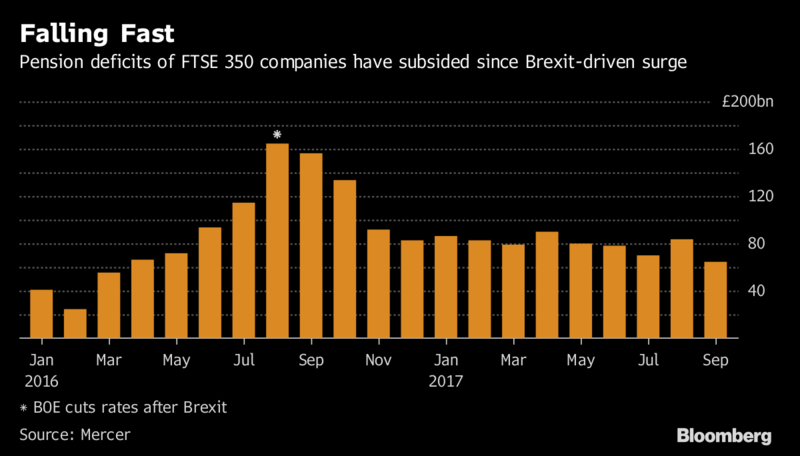
The idea that corporate Britain could fill holes in staff retirement budgets without slashing dividends would have been unthinkable even a year ago. The shortfalls of FTSE 350 companies had soared to a record 165 billion pounds ($217 billion) as the BOE cut rates to spur the economy after the Brexit vote, throttling pension income that relies on higher bond yields.

But companies have been “climbing out of a pit” since then, according to Glyn Bradley, principal of U.K. wealth at Mercer. The gap dropped to an 18-month low of 65 billion pounds in September, partly because pension fund managers made more on their equity investments as the FTSE 100 rallied 8 percent in the past year.


Not all investors have noticed the U-turn. The 14 firms with the biggest liabilities relative to market value have trailed the FTSE 350 by 10 percentage points since Brexit, according to data compiled by Bloomberg and RBC Capital Markets.

The game changer will be if BOE Governor Mark Carney raises interest rates to contain inflation triggered by the pound’s post-Brexit decline. Traders see him hiking rates by 50 basis points in the next 12 months, possibly starting as early as the BOE’s Nov. 2 meeting. If the long-term yield on corporate bonds moves by the same amount, that could potentially bring the pension deficit down to about 12 billion pounds, according to Mercer estimates based on current conditions.


Earlier Death

What’s left of the shortfall, meanwhile, could be eliminated if listed companies used the latest longevity forecasts from Continuous Mortality Investigation Ltd. in their retirement budgets. Last year, CMI cut projected lifespans for people aged 65 versus the 2013 figures many companies still plug into their models.

“We may well start to see the aggregated deficits across the defined-benefit universe disappearing, perhaps even moving to a small surplus over the next year or so,” Bradley said from Manchester.

Adopting the newer longevity statistics helped Tesco Plc more than halve its deficit between February and August. If BT were to switch, it could knock 1.3 billion pounds from its almost 10 billion-pound deficit, according to Gordon Aitken, a London-based analyst and actuary at RBC. He says BT and Marks & Spencer will benefit most from the revision in longevity.

“Money that gets paid to pension schemes is cash, so it’s money that could go to dividends,” Aitken said.

A BT spokesman declined to speculate on potential changes to the company’s pension scheme, citing an ongoing triennial review by trustees. A spokeswoman for Marks & Spencer didn’t respond to messages.


Final Salaries

Given how pervasive pension shortfalls have been this decade, some investors may wait for confirmation that deficits can narrow further before jumping in.

A lot could go wrong, after all. Stalled Brexit talks might put pressure on an economy facing the slowest growth since 2012, which would hinder the BOE’s ability to raise interest rates. If inflation keeps accelerating from five-year highs, that would eat into the pension income. And many factors beyond interest rates move bond prices.

But any evidence that pension deficits are sliding could also ease political pressure on business executives to stop prioritizing shareholders over pensioners — a practice that’s come under greater scrutiny since retailer BHS Group Ltd., and more recently Monarch Airlines Ltd., collapsed and left their pensioners uncertain about the integrity of their policies.

Defined-benefit schemes, which typically guarantee retiring Brits a percentage of their final salary, became untenable for some firms during the era of ultra-low interest rates that followed the global financial crisis. While most companies scrapped them in favor of less-onerous defined-contribution pensions, millions of legacy policies continue to weigh on corporate balance sheets.

While Millington of Aberdeen Standard Investments has been buying shares of life insurers like Aviva Plc and Just Group Plc that win from slowing improvements in mortality, he said the most pension-ridden companies would naturally be slower to lure money managers.

“Investors are just starting to see this trend in U.K. longevity, but many aren’t yet willing to believe it will continue,” he said.


Now is the time you should be looking to get a valuation on your final salary and maybe moving it in to a SIPP, with interest rates going up your pension valuation will go down….take advantage of this being the right time for a free pension valuation, email me at syeomans@farringdongroup.com


Have a good day

All the best

Stuart

CEO

Farringdon Group

+60 3 2026 0286


Article – Courtesy of Bloomberg News