
Algebra – Farringdon Group Ltd Launch Asia’s First Shariah Compliant Robo-Advisor on July 10th

“Farringdon Group, an investment and fund management firm headquartered in Labuan, has announced that it will launch a robo-advisory service on July 10. The platform, named Algebra, is based on Shariah investment guidelines and uses a Shariah investment strategy that has been approved by Amanie Advisors founder and group chairman Datuk Dr Mohd Daud Bakar.”


Asia’s First Shariah Compliant Automated Investment Service to Launch by Malaysian Company

www.algebra2u.com

Farringdon Group, an investment and fund management firm headquartered in Labuan Malaysia,  is proud to confirm the upcoming launch of its’s new Robo adviser service which follows Shariah investment guidelines. Its Shariah investment strategy is approved by well-known Shariah Scholar Datuk Dr Daud Bakar of Amanie Advisors and the automated investment service will launch July 10th 2017.

Their new system branded as “Algebra” is aiming at revolutionising the way consumers and high net worth individuals receive investment advice and access investment products. Algebra can complete a fact find and calculate its clients risk attitude, from asking questions online. This cuts out the need for expensive consultants that ask similar questions face to face and saves the consumer money immediately.

“This really does embrace fintech and with SEA making technological advances, we feel that the time is right for us to use an automated system which can provide sound financial advice. The beauty of this system is that we do not need to cover high salaries, with sales commission and we are passing 100% of those savings onto our clients.

We have built the Shariah version of this platform and have also incorporated a Non-Shariah option. Hence, whatever your investment profile is, we can mould a portfolio around your investment principals and appetite for risk.

All we ask is for people to give it a go online and then compare our fee structure to those advisers around the region; because we feel that people will be pleasantly surprised. I personally want to stamp out these heavy commissions that charge you up to 5% to enter a fund!” said Stuart Yeomans, Farringdon Group CEO.

After talking with the Algebra team, we found that a total expense ratio would be below 1% per year. To put this into context a traditional adviser in SEA could charge up to 5% to enter a fund and then the fund manager would levy a fee between 1% – 2.5% per year. Some platforms even charge to use their structure and over a medium-term investment a client may pay upwards of 3% or more per year for advice when averaged out.

Algebra can operate with its funds, fees and administration for roughly 0.85% Total Expense Ratio (TER) per year!

We also asked Stuart, why they chose Labuan as their jurisdiction of choice?

“This was a simple choice for us, we are launching an Islamic product, so why not launch it in the Islamic financial hub of the world. Labuan has so much to offer the world, with regards to Shariah Investments and I have lived in Malaysia coming up to ten years now. So, it was a natural choice for our company that has been operating as a broker for 9 years out of Labuan.

We had an option to have our product regulated in mainland Malaysia or to register it in Labuan and focus on the wider region outside of Malaysia. This again was an easy choice for us, because we want volume business and our investments will focus on USD, GBP and EUR throughout the globe. Not to mention that I have worked very closely with the regulator in Labuan for many years and want to help with their vision of expanding products across Asia and more importantly creating jobs on the island.

We are already in talks with some of Malaysia’s banks and investment institutions, for a local RM product that they can operate under their license and welcome more companies that wish to use our system; we can simply come to an agreement for them to have our system for the local market and RM investments. We have no interest in operating a license for local currency, so are happy to co-operate with local license holders and the authorities to give them our system.”

Algebra’s team want to lay the path for lower fees and to change the advisory market as we know it. Essentially offering quality advice with lower fees.

Investment Selection

Algebra relies on smart beta trading algorithms to derive its active equity portfolio, it then blends this with fixed interest ETF’s or Sukuk bond funds, to derive a risk weighted portfolio suitbale for an investors risk appetite.

 “Our team spent a great deal of time developing the smart beta algorithm that powers Algebra. Our smart beta strategy is one of the few Islamic investments in the world which outperforms the sharia S&P 500 index and does so with a lower level of volatility.” said Martin Young Farringdon Asset Management’s CEO in Singapore.

Landing Page

For any additional information or interviews, please contact Stuart Yeomans on the below details:

syeomans@farringdongroup.com

+60 17 315 7543

If you are from the banking or investment industry we are holding a launch event for C level, please get in touch if you would like to reserve your place.

Week 26 in Review: Eurozone Sentiment near 10-year High


Central bankers sing more hawkish tune

US Q1 GDP revised up

Eurozone economic sentiment soars

Brazil’s president faces corruption charges

Venezuelan crisis intensifies


Global equities fell modestly this week amid speculation concerning Europe scaling back monetary stimulus. Yields rose on the talk, with the 10-year Treasury note ending the week at 2.29%, up from 2.15% a week ago. Oil prices recovered some of their recent losses, rising to $45.40 from $42.65 last Friday. Volatility, as measured by the Chicago Board Options Exchange Volatility Index, ticked up to 10.9 from 10.6.

GLOBAL MACRO NEWS

Easy money epoch at an end?

Markets turned turbulent this week after a series of hawkish comments from developed-market central bankers suggested the era of ultra-loose monetary policy may be nearing its end. European Central Bank president Mario Draghi’s speech on Tuesday to a gathering of central bankers in Portugal was read as suggesting that the ECB is considering curbing its asset-buying program. The ECB pushed back on that interpretation, but the market refused to be spun. European bond yields rose sharply, as did the euro on foreign exchange markets. Bank of England governor Mark Carney, after saying only a week ago that now is not the time to raise interest rates, reversed course and said the Monetary Policy Committee will debate a rate move in the next few months. Not to be outdone, US Federal Reserve chair Janet Yellen and Vice Chair Stanley Fischer both voiced concerns that equity and other asset valuations are on the rich side, which suggests that financial stability worries could keep the Fed on a tightening path, despite easing US inflation pressures.

Despite the somewhat more hawkish tone, inflation pressures remain extremely muted, except in the United Kingdom, where currency pass-through is boosting prices. To illustrate this point, the eurozone reported on Friday that consumer prices rose only 1.3% in June versus a year ago, down from 1.4% in May. That’s well below the ECB’s near-2% target.

US growth revised higher to start year
US economic growth in the hard-to-measure first quarter of the year was revised higher for a second time on Thursday. Gross domestic product expanded at a 1.4% annual rate, the US Bureau of Economic Analysis reported. That’s up from the 1.2% reading in the last revision. Improved consumer spending was the main driver of the revision, the BEA said. The initial Q1 reading, released in April, was a particularly anemic 0.7%.

Eurozone confidence near a 10-year high
The eurozone economic sentiment indicator (ESI) jumped to a nearly 10-year high of 111.1 in June from 109.2 in May, with optimism on display in all sectors of the economy, according to a report by the European Commission. The ESI reached 111.8 in August 2007, just before the global financial crisis began to intensify.

Temer charged with corruption

Brazilian president Michel Temer was formally charged this week with receiving bribes totaling $152,000. The charges come less than a year after he took office, in the wake of the impeachment of Dilma Rousseff. Temer is the first sitting president of the country to be charged with a crime. In addition to the bribery count, the president may also face obstruction of justice charges, according to press reports.

Venezuelan crisis takes bizarre turn
A stolen police helicopter strafed and dropped grenades on Venezuela’s Supreme Court and Interior Ministry headquarters this week as protests against President Nicolas Maduro intensified. Some categorize the attack as an attempted coup against Maduro’s government, while others say the incident was staged by his supporters. The political tumult comes against the backdrop of a deepening economic crisis fueled by runaway inflation, food shortages and falling government revenues stemming from weak oil prices.

Have a great week ahead

All the Best

Stuart

CEO

Farringdon Group

+60 3 2026 0286


Week 25 In Review

Oil Enters Bear Market

For the week ending 23 June 2017

· Crude oil prices decline more than 20% from recent highs

· Brexit negotiations begin

· BOE governor, economist split over rate moves

· MSCI admits China’s A shares

· Fed’s Powell OK with relaxing Volcker rule

Global equities slipped overall this week, but not before the S&P 500 Index posted a fresh record high early on. Falling oil prices have been a cause for investor concern. West Texas Intermediate crude continued its decline, slipping to $42.65 a barrel on Friday from $44.70 a week ago, trading near a seven-month low. The yield on the US 10-year Treasury note was virtually unchanged, while volatility, as measured by the Chicago Board Options Exchange Volatility Index (VIX), declined slightly to 10.6 from last Friday’s 10.9.

GLOBAL MACRO NEWS

Crude oil prices deepen slump

The price of a barrel of West Texas Intermediate crude oil extended its decline this week amid rising global inventories. WTI prices have fallen in excess of 25% from their $58.30 high, which was posted on the year’s first trading day. Energy company shares have been under pressure, while spreads in the sector’s high-yield bond market have widened over benchmark Treasury yields this week. The sharp decline in energy prices will make it that much more difficult for the US Federal Reserve to reach its 2% inflation target in the foreseeable future.

Brexit talks underway

Negotiators from the United Kingdom and the European Union met on Monday in the first formal Brexit negotiating session. The one breakthrough from the talks was the UK’s acquiescence to EU demands that the divorce bill must be settled before the EU begins to negotiate a new trade arrangement. Late in the week, Prime Minister Theresa May met with EU leaders in Brussels and laid out her plan to protect the rights of the three million EU citizens living in the UK, allowing them permanent residence. May called on leaders to grant British citizens living in the EU the same rights.

To hike or not to hike?

That is the question on the minds of the members of the Bank of England’s Monetary Policy Committee. While UK growth has suffered a downturn of late, inflation has surged on the heels of a tumble in the pound’s exchange rate. Rising import prices have pushed consumer prices up 2.9% versus year-ago levels, prompting three members of the short-staffed MPC to vote for a rate hike last week against five votes to leave policy unchanged. The divide deepened this week as the Bank’s two most high-profile officials came out on opposite ends of the question of whether rates should be raised this year. BOE governor Mark Carney made the case that now is not the time for rate hikes given low wage growth and mixed signals on consumer spending and business investment. BOE chief economist Andy Haldane countered that it would be prudent to raise rates in the second half of this year to counter the inflation surge. It is rare for a central bank to defy the will of its leader, and it appears unlikely to happen in this instance given recent shifts in the MPC’s composition.

China gets nod from MSCI

After years of fighting for inclusion in MSCI’s influential stock indices, China finally received word that some of its A shares will be included in the indices in mid-2018. Just fewer than half of the 448 A shares will be included in the indices and at an initial weighting of just 5% of each stock’s market cap. These restrictions are an effort by MSCI to incentive China to further liberalize its stocks markets.

Room to relax

Fed governor Jerome Powell told a congressional committee that US regulators have room to relax or eliminate some aspects of the Volcker rule, which is intended to limit banks’ ability to make speculative bets with insured deposits. Regulators are looking for ways to simplify the complicated rule and may exempt small banks from having to comply, Powell said.

Treasury secretary rejects one-off ultra-long bond

US treasury secretary Steven Mnuchin this spring floated the idea that the United States is considering issuing very-long-dated bonds. This week he said the government will only issue ultra-long maturity Treasuries if there is sustained appetite for the securities. Mnuchin said his department is reaching out to investors in order to gauge demand for instruments with maturities between 50 and 100 years, but any move to issue very-long-term debt would not be a one-off. Apparently there is at least some investor demand for long paper, as Argentina issued 100-year bonds this week despite having defaulted six times in the last century. The issue, although rated below investment-grade, was heavily oversubscribed.

US banks clear first round of stress tests

Thirty-four big US banks passed the first round of the Fed’s stress test this week. Next week, the central bank will announce whether it will allow the banks to return capital to shareholders. Some banks may begin to reduce their capital if the Fed approves. That could be seen by markets as a sign of confidence that the banking system is strong and positioned well to withstand a significant economic downturn.

Have a great week ahead

All the Best

Stuart

CEO

Farringdon Group

+60 3 2026 0286

The UK Company Pension Crisis

The Final Salary Pension Scheme

The black hole in Britain’s final salary pension schemes has grown to a record £390 billion, new data suggests. The deficit of all UK private sector defined benefit schemes has rocketed by £135 billion in the past year alone, the equivalent of a £2.6 billion increase every week, JLT Employee Benefits said. Widening pension deficits are in part triggered by ultra-low interest rates, which drive down the returns on Government bonds held by pension funds

http://www.thisismoney.co.uk/money/pensions/article-3686601/Total-deficit-final-salary-schemes-soars-90bn-384bn-Brexit-hits-funds.html

In monetary terms, Royal Dutch Shell has the largest pension deficit. The energy company currently has over £9.5 billion of pension liabilities, equating to a pension deficit of 15%. BT and BP are close behind with £7.5 billion and £7.3 billion of pension liabilities respectively.

BT is appealing to the fund’s trustees and telecoms unions to agree to end accruals in its defined-benefits pension scheme. It has more than 300,000 members and is the UK’s largest private-sector retirement fund.

http://www.telegraph.co.uk/business/2017/05/27/bt-cap-pension-pots-fill-14bn-hole/

https://www.theguardian.com/money/2016/sep/01/uk-defined-benefit-pension-fund-deficit-grows-100bn-one-month-pwc

In the last 12 months, the total disclosed pension liabilities of the FTSE 100 companies have fallen from £614 billion to £586 billion. Ten years ago, the total disclosed pension liabilities were £407 billion. A total of 16 companies have disclosed pension liabilities of more than £10 billion, the largest of which is Royal Dutch Shell with disclosed pension liabilities of £57 billion. A total of 21 companies have disclosed pension liabilities of less than £100 million, of which 12 companies have no defined benefit pension liabilities.

Situation update

The combined deficit of UK pension funds hit £500 BILLION! To put this in context, it’s the same amount as the GDP of Thailand or South Africa!

http://pwc.blogs.com/press_room/2017/04/uk-pension-fund-deficit-falls-to-500bn-according-to-pwcs-skyval-index.html

Pension experts are predicting that final salary pension schemes could be consigned to the history books, not in decades, but in just three years, as schemes close their doors to new members.

Why?

  • Low gilt yield (UK government bond interest)
  • Poor performance
  • Members not contributing enough
  • Higher life expectancy

The Pension Protection Fund (PPF), the government’s private enterprise safety net (not funded or guaranteed by the government) for members of final salary schemes, has stated there are over 5,142 schemes in deficit—representing 81.4% of all UK pension schemes.

The average deficit in funding for clients with UK schemes that I have met is 33%. That’s scary.

What could force a scheme into the PPF?

A firm becoming insolvent or pension fund trustees that just can’t handle the deficit. However, there have been recent cases of firms pushing away their pension fund liabilities.

A recent example of this is when UK Coal went into administration, and their 7,000-member pension pot went into the PPF. This is because the group responsible for repairing the pension deficit, of at least £450mn, sank into a long-anticipated administration.

This means that the guaranteed pension members were expecting will be drastically reduced by up to 50% in some instances.

Some schemes that are on my watch list have huge liabilities:

  1. BT Group plc, British Airways and BAE Systems plc (the old privatized industry)
  2. The National Health Service and any Civil Service pension
  3. The Royal Bank of Scotland plc
  4. Barclays plc
  5. Royal Dutch Shell plc

Interest Rates linked to Pension Pot Values

Transfer values are at an all-time high currently, this is due to the post Brexit environment with government bond rates being at an all-time low, as they are correlated with interest rates, meaning employees are getting transfer offers around 30% to 40% higher than they were a few years ago.

Indeed some of these values have increased by as much as 25% in just the last 9 months. Bearing in mind interest rates haven’t been this low in over 200 years, they will soon start to rise, possibly by Q4 this year or the beginning of 2018 meaning the values of Pensions will drop dramatically, add that to a potential reduction in employees benefits in the future by the government, UK Pension schemes will be shockingly bad in the coming years.

https://www.ftadviser.com/pensions/2017/03/08/db-transfer-values-back-to-near-record-highs/

Annuity rates plummet, making 2017 ‘worst year for payouts

https://www.theguardian.com/money/2016/sep/14/annuity-rates-plummet-2016-worst-year-income-retiring-pensioners

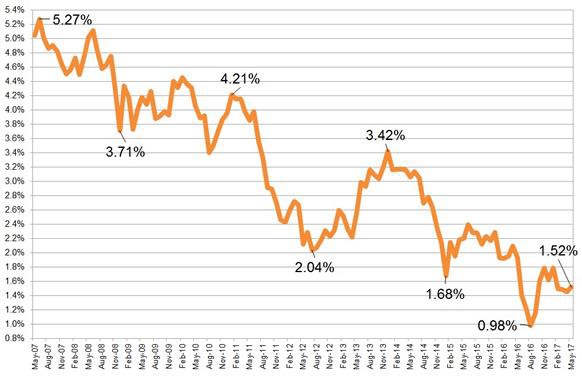
2007 = 4.6% – 2014 = 3.2% – 2016 = 2.1% – 2017 = 1.5%
www.sharingpensions.co.uk

Annuity rates are based primarily on the 15-year gilt yields so changes in gilt yields will affect annuities. The above chart shows yields reached an all-time low of 0.90% on 11 August 2016 after an interest rate cut to 0.25% and £70 billion of quantitative easing. The 15-year gilt yields had reduced significantly since June 2008 due to the financial crisis and this has had the effect of reducing annuity rates.

The drop is the biggest recorded and means over 55s swapping their pension pot for a guaranteed income in retirement today are now faced with some of the worst deals in history as annuity incomes have hit an all-time low.

Data from savings website, Moneyfacts, shows the average standard annuity income for a 65-year-old has fallen by 14.8pc on a £10,000 deal and by 15pc on a £50,000 deal so far during 2016, with potential to fall even further.

Steven Cameron, pension’s director at Aegon, added: “With annuity prices at an all-time low and unlikely to recover soon, people need to start thinking differently and keep their options open. Putting off retirement, continuing to work and save will be an option for some.”

How can they fix the Final Salary Pension problem?

The governments are in talks to allow UK companies to start cutting benefits which is currently being reviewed and will be decided by the winter autumn statement in December 2017. Also remember how harsh they have been in the last year by changing IHT property tax, lowering the LTA (Pension Life time allowance on IHT), putting a 25% tax on moving your pension into a QROPS and changing the Shell offshore Pension scheme to 100% taxable residing in the UK. They are also looking at removing the Pension commencement Lump Sum tax free benefit.

Any future changes the government plans to make, will be unlikely to come with any prior warning allowing you to move your pension and retain the tax benefits.

The problem is so big it is causing economic risk to the whole Pension system and the financial system, the FTSE 100 for example would have to hold back dividends for 1 full trading year, which is not going to happen. Halt trading??

What can you do?

You can move your UK Company Pensions into a Self-Invested Personal Pension (SIPP) is the name given to the type of UK government-approved personal pension scheme, which allows individuals to make their own investment decisions from the full range of investments approved by HM Revenue and Customs (HMRC).

SIPPs are a type of Personal Pension Plan. Another subset of this type of pension is the Stakeholder Pension Plan. SIPPs, in common with personal pension schemes, are tax “wrappers”, allowing tax rebates on contributions in exchange for limits on accessibility. The HMRC rules allow for a greater range of investments to be held than Personal Pension Plans, notably equities and property. Rules for contributions, benefit withdrawal etc. are the same as for other personal pension schemes

http://www.telegraph.co.uk/pensions-retirement/financial-planning/now-time-cash-final-salary-pension/

Benefits:

  • It is a UK Pension Wrapper of your company pensions (You can consolidate all of your pensions under one scheme)
  • Much wider selection of investments
  • You can hold the pension in multiple currencies
  • The internal investments are free of income and capital gains tax
  • Take early retirement at 55 rather than 60/65 with Final Salary
  • 25% tax free lump sum at 55% depending where you are residing
  • On the event of your death your wife/family will get 100% of the remaining pension fund, (Final Salary Scheme – You will only receive 50%/60%, then should anything happen to your wife the children will get 0) with a SIPP they will get 100% of the remaining pot, allowing for greater inheritance benefits.

If you have a frozen defined benefit (DB) pension plan or final salary scheme, there has never been a better time to transfer into a SIPP Self Invested Personal Pension. WHY?

Transfer values are 80% higher today than they were six years ago, due to post Brexit and extremely low interest rates, which will not last long possibly by the end of 2017

Sit down and review your current situation, including the pension itself and the scheme. We have seen an increase in individuals who are fearful of the current UK pension crisis—with good reason.

However, there is an unprecedented window of opportunity available to eligible DB scheme members today, that may not be there by the end of this year.

Due to the complex and convoluted nature of pensions and pension transfers, we have an established a specialist pensions division and commissioned independent actuaries to review and report on the status of pension schemes for interested individuals.

This is a simple step to initiate, with no obligation to act on the results of the review. In many cases this action has already preserved and protected significant transfer amounts, converting a future promise into a real investment today for the benefit of the scheme member, spouse, children, and children’s children.

If you would like a valuation on your pension please contact me directly on +60 3 2026 0286 or email to stuart@farringdongroup.com and we will uncomplicate this information and inform you of the options.

Thanks and have a great day

Stuart Yeomans

CEO

Farringdon Group

Kuala Lumpur : Malaysia

If you feel that this is of interest to colleagues, friends or family, please feel free to forward this information on.
European markets hit fresh highs; US quits the Paris agreement

For the week ending 2nd June 2017

  • US nonfarm payrolls rose 138,000; March/April revised down
  • European markets hit fresh highs
  • Draghi suggests no immediate policy shift
  • UK polls narrow for Conservatives
  • US quits the Paris agreement

U.S. stocks rose for the second consecutive week, bringing the Dow Jones Industrial Average, the S&P 500 Index, and the Nasdaq Composite Index to new highs. Volatility, as measured by the Chicago Board Options Exchange Volatility Index (VIX), remained historically muted, falling to 9.9 from 10.8 last week.

GLOBAL MACRO NEWS

US adds fewer jobs than forecast

The May employment report was a disappointment save for a continued drop in the unemployment rate. 138,000 new jobs were added last month, while revisions to March and April data trimmed 66,000 from pervious totals. Economists had expected a rise of 184,000 nonfarm payrolls. Wage gains were steady at 2.5% versus a year ago. The bright spot in the report was the continued fall in the unemployment rate, which edged down to a 16 year low of 4.3%. While weaker than expected, the data likely won’t dissuade the US Federal Reserve from hiking rates later this month.

The EU in Review

Eurozone stocks posted gains for the week. Britain’s FTSE 100 and Germany’s DAX reached fresh highs as investors turn toward Europe and other developed markets. European equities saw a 10th consecutive week of inflows according to data from Bank of America Merrill Lynch. Cyclical stocks led gains, while energy stocks, which include oil and gas and renewables, were laggards, weighed down in part by news of the U.S. announcement to withdraw from the Paris agreement on climate change. European political concerns resurfaced amid the growing possibility of early parliamentary elections in Italy, but news that Italy logged better-than-expected economic growth lifted Italian stocks late in the week.

Draghi: Not ready to unwind stimulus

Appearing before the European Parliament’s committee on economic affairs this week, European Central Bank President Mario Draghi played down the odds of any shift in policy at next week’s rate-setting meeting. Economic growth is improving but inflation remains subdued, the central banker said, adding that the economy still requires substantial stimulus. Some analysts had expected the ECB to signal that it will begin tapering bond purchases later this year. Very subdued Eurozone inflation data (+1.4% year over year) released later in the week further tamped down expectations of a policy shift.

UK polls tighten

Opinion polls ahead of next week’s UK general election have been wide and varied with some showing the Conservatives with a lead as small as 3% and others indicating a lead as wide as 15%. What is not in doubt is that the race has tightened; the Conservatives held a 22% advantage on the day the election was called back in April. Not helping the Conservatives, Prime Minister Theresa May was criticized for skipping a BBC-sponsored debate, choosing instead to send a surrogate. Labour Party leader Jeremy Corbyn pounced on the decision. May tried to keep the focus on Brexit, saying Corbyn is not suited to lead those negotiations with the European Union.

US pulls out of Paris Agreement

Saying he was elected to represent the voters of Pittsburgh, not Paris, US president Donald Trump this week announced that the United States would pull out of the Paris climate deal. The agreement put the US at a disadvantage, Trump said, highlighting its lack of enforcement mechanisms. Trump offered to renegotiate the deal, though Germany, France and Italy have been dismissive of the notion.

Italy moving closer to early elections

Elections could come as early as this autumn if the Italian parliament adopts a new election law resembling German’s proportional system, with a 5% cutoff for smaller parties. If the law is approved in the coming weeks, as expected, Italians could go back to the polls around the same time as Germany votes on 24 September. The ruling Democratic Party and the Eurosceptic Five Star Movement are nearly tied atop the polls.

Europe continues to hog the growth spotlight

While manufacturing in the US and China moderated slightly in May, Europe continues to show strength. The Eurozone manufacturing purchasing managers’ index firmed to 57.0 from 56.7 in April, the highest in six years. UK PMI stayed robust at 56.7, down from April’s 57.3, while the US ISM Manufacturing Index saw slight improvement to 54.9 In May from 54.8 in saw slight improvement to 54.9 In May from 54.8 in April. China’s official PMI stood unchanged at 51.2, though the Caixin PMI dipped to 49.6 from 50.3.

EARNINGS NEWS

With 492 of the members of the S&P 500 Index reporting, earnings are expected to have increased 15.4% in the first quarter versus the same quarter a year ago. Excluding the energy sector, earnings rose 11.1%. Revenues are seen up 7.3%, and up 5.4% excluding energy.

I hope you enjoyed reading this post.

Stuart Yeomans 

CEO

Farringdon Group

Kuala Lumpur : Malaysia