Q1 – Market Outlook 2016

Stuart Yeomans - Brexit

Quarter 1 has seen a continuation of the volatility we experienced in the second half of last year with Markets dropping in the middle of the quarter then recovering towards the end, while most equity markets also ended this period flat. The S&P 500 started the quarter at 2043 and ended at 2059 while the FTSE 100 started at 6242 and ended at 6174.

Oil experienced major volatility across the period, with prices for WTI dropping as low as $26.55 before recovering to levels of around $40 a barrel. Markets have been somewhat uplifted by a more dovish sentiment emanating from the US Federal Reserve with The Fed now predicting making just two interest-rate rises during 2016 instead of the previously reported four.

China continues to weigh heavily on the collective mind of all the global markets and for the present, the situation in China appears to have stabilised with the government easing back on its market interventions which were adding to the volatility. However the nation’s economy will continue to face strong headwinds for at least the next six months.

Looking ahead this quarter, many analysts are concerned about the potential decline in company earnings with this being particularly acute in the energy and commodity sectors, however cheaper prices are already starting to move on to other downstream sectors such as airlines and manufacturers which is positive.

Markets have now been down for ten months and it seems likely to us that most bad news is already priced in and we may start to see selected companies outperforming as earnings beat the low expectations already set.

Brexit

Q2 will bring us the UK referendum on continued membership of the European Union with current polls too close to call, so we do expect to see some volatility in both the value of sterling and the FTSE 100.

Currently we expect to begin moving assets to cash across May with the view to trying to purchase back in, off the back of any resulting dip.

In the medium to longer term, we do not expect the result to have much of an impact, as it is probable that the EU and UK would rapidly negotiate a deal for continued membership of the common market. The UK is a massive net importer from the rest of the EU and the consequences of the UK being outside the single market would be quite devastating for the Netherlands, Germany, France and especially Ireland.

The bigger issue of a UK exit is likely to be in terms of the UK’s loss of free-trade agreements with other non-EU countries. However, given the UK’s status as the fifth-largest economy in the world – not to mention the fact that it is a net importer from most other countries – it would seem likely that some form of fudged deal would be reached to allow the UK to remain under EU treaties until new ones could be negotiated.

If a Brexit deal is reached we would expect governments to move quickly on such issues in order to stem any longer term uncertainty. So the Brexit vote is likely to pull the market down in the short term but will likely present us with a good opportunity in the medium to longer term.

Oil

The oil market has recovered on the assumption that the Russians and Saudis had a deal to at least freeze oil output at January levels, however the Russians have reneged on this deal by producing an additional 200,000 barrels a day in their March production figures.

The Russians have done this to The Saudis several times in the past – most notably in 2009 when they agreed to a production cut and then actually increased production. The other factor which caused oil to rally was the loss of production from Iraq and Nigeria which, due to closed pipelines, saw some 900,000 barrels a day removed from global production.

While many pundits are claiming the world is awash with oil, this is not really the case with The Saudis historically holding back a production reserve of around two million barrels a day.  This in turn has then been used to make up any losses when other supplies falter, however The Saudis are now flooding the market with this reserve, which means there is little additional spare capacity.

The current low prices have caused major damage to the exploration industry and the IEA is now predicting a major oil shortage by the year 2020 which could once again send prices back above $100 a barrel.

We are currently waiting for prices to drop to a range of $32 – $34 a barrel before recommending any additional purchases within our portfolios as we still expect to see prices in the range of $50- $60 by the end of 2016.

I hope that you have enjoyed reading this post.

Stuart Yeomans 

CEO

Farringdon Group

Kuala Lumpur : Malaysia

Should you reduce your Employees’ Statutory Contribution Rate of your EPF for 2016?

EPF

This morning I got asked by my wife, exactly what the reduction of the employees EPF contribution means; so here is a view from my side and how I would handle this tough choice.

Currently there are two parties that contribute to your EPF:

  1. You as the EMPLOYEE
  2. Your company as the EMPLOYER

Currently the EMPLOYER has a set rate of 12% each month, that MUST be sent to your EPF account.

In 2015 you as the EMPLOYEE would have 11% of your salary deducted.

In 2016, the government has decided to reduce the EMPLOYEE contributions down to 8%, hence you will end up with 3% more in your payslip each and every month.

As an EMPLOYEE, you actually have the option to fill in a form and elect to remain at 11% contributions and not have an extra 3% in your salary!

Below is the form that you will need to fill in and have processed. Unfortunately, when this article was written the website is down for maintenance, so we can’t provide a web link.

Form EPF 17A (Khas2016), Notice to Contribute More than Statutory Rate (Employee’s Share).

IS THIS A GOOD IDEA?

In my opinion I feel that most people should elect to fill out this form, you should not reduce your contributions; simply because many Malaysians do not have enough in their retirement to be self-sufficient and an extra 3% now in your hand, will not help you much in your daily life.

There is an increasing issue of people running out of money or having to have help from loved ones in later years.

The only reason to reduce your contributions, is if you do not trust the EPF or you feel that you can find a safer home for this money.

Many newspapers and articles online are saying that the main reason why the government has reduced this rate is to stimulate growth in Malaysia at its most needed time. This will also grow the GST income for the government in the short term and is a move to stabilize an already fragile economy.

CONTACT US

If you feel that you will be short in retirement and you want to look at saving some additional money towards your future, please contact us below on.

syeomans@farringdongroup.com

I hope you have enjoyed reading this post.

Stuart Yeomans

CEO

Farringdon Group

Kuala Lumpur : Malaysia

Continuation of Volatility to start 2016

Stuart Yeomans - NYSE

January has seen a continuation of the volatility that was seen in the third and fourth quarters of last year. However, despite substantial drops in the middle of the month, equity markets ended the period relatively flat.

Oil

Oil has experienced further drops across January, touching a low of $26.55 on WTI and $27.10 on Brent. Prices climbed back up substantially from these lows, to levels around $34 a barrel. However, this move upwards seems to be based on market speculation and we expect to see prices fall again in the near term. We believe that oil will bottom out in the mid 20’s, before rounding sharply in the second half of the year. While prices of $27 a barrel are below the marginal production costs for many wells, it is important to remember that these are prices of high grade crudes. Lower grade crudes that make up much of the world’s production, are trading at much lower prices. Last month North Dakota Sour Blend, was trading at a negative price of -$0.50. These low prices should mean that many wells around the world begin to shut down later this year, helping to restore balance to the market.

In addition to this, there is now talk from Russia about joining OPEC in making a 5% production cut. This offer has been rebuffed by OPEC members. However, it will be in all of their best interests to get a deal at some point. A 5% global production cut would see prices quickly move in the $80 a barrel range.

China

Data from China continues to weigh heavily on the minds’ of most markets. However, many underlying indicators such as house prices and car sales, seem to be indicating that the economy has returned to stronger growth. Other figures such as the Purchase Managers’ Index data, indicate recessionary pressures inside the country. It is hard to tell which sets of data are correct and this uncertainty is one of the principal reasons why the markets have experienced heavy volatility.

Outlook

The first quarter will remain volatile, however it looks increasingly unlikely that the world is headed into a recession in 2016. This should translate into higher values across all asset sectors by the end of the second quarter.

I hope you have enjoyed reading this post.

Stuart Yeomans

CEO

Farringdon Group

Kuala Lumpur : Malaysia

2016 Turnaround in Emerging Markets

While 2015 has seen some of the steepest falls in emerging markets, next year could see a reverse in the situation. Over the last few years part of the problem has been the drag effect caused by higher currencies, commodity price increases’ and higher wage levels. However, many of these factors have reversed over 2015 and many emerging markets may be set for a strong growth period. Amongst them are the following;

  • EM growth is already at the weakest in 20 years barring the 2008 crisis.
  • Global trade is already flat on its back, while emerging markets trade is in clear recession. In volume terms EM imports have shrunk 2.6% in first 8 months of 2015. Global growth is weak, but global trade is much weaker than has been associated at this level of growth, suggesting a change in the beta of trade growth to output growth. Weak exports will hardly be a surprise for anyone. In value terms, trade may also improve next year, because of weak commodities and a stronger USD.
  • The deficit in certain countries current accounts is slowly narrowing. India and Indonesia deficits don’t present a big problem in themselves, and the larger deficits of Brazil, South Africa, Turkey, Colombia and Peru have also shrunk in USD terms.
  • Commodity prices have already plummeted: Based on CRB raw industrial prices, commodities have now slipped to their lowest average level of the last 20 years. They have been falling since Q2 2011, but the decline since April 2014 has been significant. Coal, oil, iron ore, nickel and Aluminium are particularly weak.
  • Over the last 5 years, emerging market equities have already underperformed developed market equities by 60% and in addition to this emerging market bonds have also underperformed US T Bills by 27.5%. The USD has rallied 43% against a spot basket of 20 liquid EM currencies and EM sovereign spreads have been flat against an average of US and EU high yield spreads, despite being rated higher.

In addition to this, we may well see other factors come into play, such as China’s new stimulus package, which will help boost its economy. With a recovering China, this will boost the entire region and even global growth. In addition to this we may see reforms from a new government in India or Indonesia as well as the chance for reducing sanctions on Russia and Iran.

While EM’s are likely to continue to experience volatility in the short term it seems increasingly likely that the worst is over and it may be time to once again begin considering a healthy level of exposure.

I hope you have enjoyed reading this post.

Stuart Yeomans

CEO

Farringdon Group

Kuala Lumpur : Malaysia

What you ought to know about the falling Malaysian Ringgit and why it will not recover soon!

Love or hate stories that are negative about the currency that you use on a daily basis, it is something we all need to understand and more importantly plan for!

I held a seminar two weeks ago and I was surprised with how many people agreed that Malaysia’s currency is not going to recover quickly. The room was filled with Malaysian citizens and from my previous seminar experiences, Malaysian’s will normally fight for the positives and why their currency will recover and things will be Ok……. but this time, something was different, it was obvious that concern for livelihood outweighed any hope for their government to right the freefalling currency.

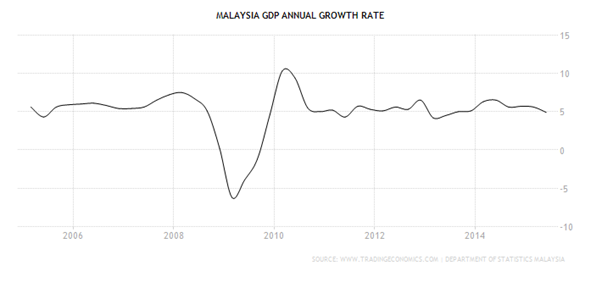
 The first thing to look at is Malaysia’s growth…..or should I say Putrajaya’s quote of 4.5% – 5.5%. This to me is a bold statement and with the current political issues, economic issues, I find this hard to believe. One issue to begin with is the way Asia and the West state their figures in the first place.

In the West, it’s common for predictions to be put out there and then often revised up. This is most likely to give that positive news that they beat predictions and confidence grows. Whereas in the East it is the other way around, figures are stated and then often revised down. I for one fear a prediction of 4.5% – 5.5% is a little too confident and I would like to explain why with facts and figures.

GDP


“According to S&P, Malaysia has the highest personal debt among 14 Asian economies, with the rate jumping to 88 percent of gross domestic product from around 60 percent in 2008.” 07/09/2015

In addition to this, Moody’s uprated Malaysia rating to a neutral outlook in June, however were in KL as little as three weeks ago to reconsider this and I fear with the current climate, Malaysia will be put back to A- negative outlook.

Here are a few facts that I have pulled from media recently.

  • Malaysia’s manufacturing sector recorded a sharp decline in activity in August, with new orders contracting at the fastest rate since September 2012
  • The headline Purchasing Managers Index (PMI) dropped to 47.2 ― down from 47.7 in July ― which the index rated as the “strongest deterioration in operating conditions” for Malaysian manufacturers in nearly three years
  • New orders at Malaysian goods producers contracted for the sixth month in a row
  • Moreover, the rate of decline was the second-sharpest in the series history
  • Job hiring have posted a 26 per cent decline this year
  • The Malaysian equity index fell 15 per cent from its July 2014 high
  • The MYR currency is Asia’s worst performer this year as political uncertainty clouded the outlook amid an emerging-market selloff

Now let me cover a couple of MAJOR factors as to why Malaysia’s RM will not recover quickly and the economic outlook is poor.

Putrajaya have played down the importance of Oil and said that Malaysia has many other factors that will assist in good GDP figures in 2015.

Before I disprove Putrajaya’s poor comments, let me start with Oil.

In 2014 oil revenue were 31% of Malaysia’s GDP and for 2015 this is expected to fall to 22% based on oil at USD55.

Oil has faltered this year and gone down as far as USD38. This in itself should mean that even a 22% prediction will most likely be in the teens.

Many pro government writers begin telling you that we should not worry, our economy is based on so much more…….so what are they?

  • Tourism: Q1 stats show 600,000 less visitors and this expected to be worse in Q2, not to mention the world media damaging Malaysia as a peaceful country. This will of course cause holiday makers to reconsider coming to Malaysia for a holiday, despite a weak currency. What family would risk their children’s safety when all they see is multiple rallies, murders, corruption! Whether these stories are true or false, it paints Malaysia in a very bad light and I believe tourism figures to be very bad in Q3 and Q4.
  • Natural Gas : Prices have been down and very low for a decade and I will not dwell too long on proving this, you can have a google and see this for yourself
  • Banking & Services: Scandals and a falling RM, destroy confidence in the markets. Whether stories are true or not, people simply do not trust the Malaysian banking sector at the moment and large amounts of deposits are leaving the country
  • Palm Oil : Production is drastically down since December 2014 where it dropped 11% and figures do not seem to be recovering

I do not for see the RM bouncing back anytime soon and I fear that even with the government’s new stimulus package this will simply flat line it at current levels for a few weeks/months. Ultimately, Asia is in crisis, with the RM being the bottom of the pile.

Predictions:

  • Numerous rating agencies will initially say that Malaysia is being watched stringently and most likely they will be put on a negative rating or even worse drop the A- lower. (Fitch: Recently moved this up to A- with a neutral standing)
  • International perception of Malaysian markets will go from bad to worse, because bad news sells!
  • Banks will become less willing to lend and debt collection will be paramount. Mr Chaucer on BFM in September clearly shows that lending and banking deposits are close to 1 : 1. This means that lending is now drying up and house and car loans are already decreasing
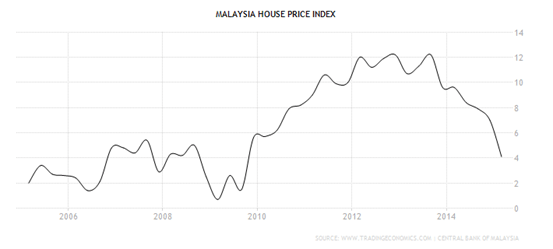
  • The knock on effect of this is the housing market, which I have said in previous stories that it is way overpriced and you can see on the graph below that transactions have gone to a third of where they previously were. Event those property agents that always tell us everything is fine can have a dose of reality now that they see that housing is the next thing to go down.
  • These low house sales, drying up of lending and negative equity will result in home owners owing more than their homes are worth and repossessions will rise. I witnessed this in the UK market crash and Malaysia has a lot of similar alarm bells ringing. Even those people that think landed property will be fine………I will prove myself right in the coming quarters. Malaysia’s house prices whether in apartments or landed, will fall and I can’t see them coming back quickly. People are renting houses at less than 2% rental yield……..my house is 1.8% for my landlord, so I can see this with my own situation.

Housing transnational history


  • This will be the same with car loans & those people who can’t even afford a 1 bedroom apartment but drive a brand new Porsche Cayenne on finance will also start to worry!
  • The housing market correction, bad economic data, job losses increasing, oil prices staying down and corruption issues will take a minimum of 2 – 3 years to put right and the low RM rate is here to stay for some time.

I consider Malaysia my home and I see that it has so much potential, but at the moment, economically, politically and perception is not great. The best thing for people to do is speak to a professional about how to limit their exposure to these issues and maybe consider investing away from Malaysia. I for one, certainly think that anyone holding too much RM will be best advised to move it to a strengthening currency.

Thanks for reading

Stuart Yeomans

Farringdon Group CEO

Malaysia to stimulate new economic plan


Stuart Yeomans - KLFor a country currently grappling with its economy, a rejuvenating new multi-billion dollar plan was recently announced by Prime Minister, Najib Razak. Since the dawn of 2015, the prime minister has been constantly facing a slower pace of economic growth and a currency losing nearly a fifth of its value versus the US Dollar.

The government is apparently ready to throw in billions of dollars into financial markets while investigators continue to probe a troubled state investment fund 1Malaysia Development Berhad (1MDB) which was formed by Mr Najib himself in 2008, and who also sits as chairman on its advisory board. In a speech on Monday, Mr. Najib assured that his government “remains committed to helping solve investigations in relation to the investments of 1MDB transparently.” He added that all 1MDB’s dealings will be “transparent and market-friendly.” As the Prime Minister deals with accusations of corruption, he is definitely keen on concentrating on the economy instead.

External shocks aren’t the only reasons for the recent worries over Malaysia’s economy – as repeatedly outlined by the Najib administration – citing the skyrocketing US dollar and slowdown in China, a major trading partner. Weak commodity prices and a slowing Chinese economy have hit Malaysian markets hard and added pressure on the Prime Minister, as evidenced by recent street demonstrations challenging his rule.

Amidst these worrying developments, the much-talked about Malaysian leader introduced the “Special Economic Committee”(JKE) last month, whose members include his brother, CIMB Bank chief, Nazir Razak, who coincidentally, has been a huge critic of 1MDB – as well as Tan Sri Nor Mohamed Yakcop, the man famed for implementing a currency peg and capital controls that the country put in place following the 1997 Asian financial crisis. But the Najib administration has vowed not to repeat those measures, insisting that economic fundamentals are resilient and will remain unaffected by current pressures.

Also on Monday, Mr Najib added that a state firm called ValueCap would be investing 20 billion Ringgit ($4.6 billion) in a few of the country’s worst-hit stocks and advised other quasi-independent state firms with operations overseas to cash in those investments and return to reinvesting in Malaysia. Arguably, this hasn’t been the first time Mr. Najib has managed to leverage state muscle to boost the economy and markets.

It is vital to note that the Ringgit is currently Asia’s worst performing currency this year trading at over 4.3 to the US Dollar all of last week and ending Friday at 3.05 to the Sing dollar. But analysts believe the measures announced on Monday may cushion the slide for the short term.

I hope you have enjoyed reading this post.

Stuart Yeomans

CEO

Farringdon Group

Kuala Lumpur : Malaysia